


 Home /
Lithium Polymer vs. 18650 Batteries for Breast Pumps: Which Is Better?


Table of Contents
- 1. Understanding Lithium Polymer and 18650 Batteries
- 2. Lithium Polymer vs. 18650: Key Differences
- 3. Which Battery Fits Wearable Breast Pumps?
- 4. When Is an 18650 Battery a Better Option?
- 5. Battery Capacity and Pumping Runtime
- 6. Safety and Charging Design Considerations
- 7. How Should OEM Manufacturers Make the Final Decision?
- 8. Custom Breast Pump Battery Solutions from Gloflux
- Frequently Asked Questions
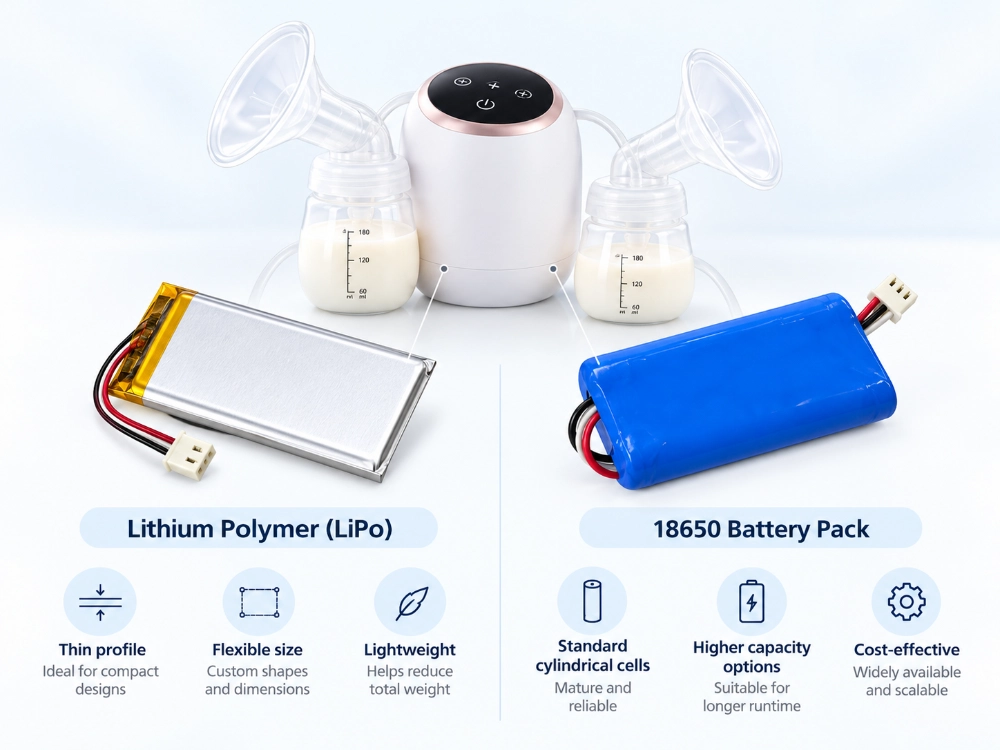
Choosing the right breast pump lithium battery is an important decision for manufacturers developing rechargeable breast pumps. Battery selection affects device dimensions, operating time, weight, charging performance, and production costs.
Two common options are lithium polymer (LiPo) pouch batteries and cylindrical 18650 lithium-ion batteries. Both can power electric breast pumps, but their physical structures and integration requirements differ.
For OEM manufacturers, the better choice depends on the pump's mechanical design, electrical requirements, and intended usage.
1. Understanding Lithium Polymer and 18650 Batteries
Lithium Polymer Batteries
Lithium polymer batteries generally use a flat pouch structure enclosed in aluminum-laminated film. Their dimensions can be customized to fit compact electronic products.
For wearable breast pumps, pouch cells can occupy relatively thin spaces inside the housing, leaving room for the motor, control PCB, suction mechanism, and milk collection components.
Common design advantages include:
- Flexible length, width, and thickness options
- Lightweight packaging
- Efficient integration into compact battery compartments
- Custom wiring and connector configurations
However, pouch cells require suitable mechanical support and protection against compression, puncture, and swelling.
18650 Lithium-Ion Batteries
An 18650 battery is a cylindrical lithium-ion cell measuring approximately 18mm in diameter and 65mm in length.
These standardized cells are widely used in rechargeable electronic equipment. Manufacturers can combine them into battery packs based on their voltage and capacity requirements.
Potential advantages include:
- Standardized cell dimensions
- Multiple capacity and discharge-current options
- Established supply chains
- Suitability for modular battery pack assembly
Their cylindrical shape, however, may create packaging challenges in very thin wearable devices.
2. Lithium Polymer vs. 18650: Key Differences
Both battery types can deliver dependable power when properly selected and integrated.
| Design Factor | Lithium Polymer | 18650 Lithium-Ion |
|---|---|---|
| Cell shape | Flat pouch | Cylindrical |
| Dimension flexibility | High | Fixed standard format |
| Thin-device integration | Generally easier | Requires sufficient thickness |
| Mechanical protection | Needs external support | Metal cell casing |
| Capacity options | Cell-size dependent | Standard cell ranges |
| Pack assembly | Customized pouch integration | Series/parallel arrangements |
| Best application | Compact wearable pumps | Portable pumps with adequate space |
The comparison does not mean that lithium polymer batteries are automatically safer, lighter, or more energy-efficient in every application. Performance depends on the selected cells, protection system, and complete battery pack design.
3. Which Battery Fits Wearable Breast Pumps?
Wearable breast pumps typically integrate the motor, electronics, battery, and collection system within a compact housing.
This creates strict space limitations.
A flat lithium polymer cell may fit more efficiently around internal components, particularly when the available battery compartment is shallow.
For example, a manufacturer developing a slim wearable breast pump might prioritize battery thickness and connector placement over the convenience of standardized cylindrical cells.
However, battery selection must also consider motor startup current, charging heat, and housing ventilation.
A pouch battery should not be compressed or bent to fit a confined compartment.
For OEM projects, the available installation space should be confirmed before choosing a specific cell model.
4. When Is an 18650 Battery a Better Option?
Cylindrical 18650 batteries can be suitable for portable electric breast pumps with larger internal compartments.
These products may accommodate one or more cylindrical cells without significantly affecting the external design.
For example, a 7.4V, 2600mAh battery pack using two nominal 3.7V, 2600mAh cells in a 2S1P configuration provides approximately 19.24Wh of nominal energy.
This is an illustrative electrical configuration, not a universal breast pump requirement.
A properly designed pack may also incorporate a protection circuit, insulating materials, connecting wires, and a compatible electrical connector.
Manufacturers considering this structure should confirm that the cylindrical cells fit securely without interfering with the motor or mechanical assembly.
5. Battery Capacity and Pumping Runtime
Battery capacity influences how long a rechargeable breast pump can operate between charging sessions.
However, comparing batteries by mAh alone can be misleading when their nominal voltages differ.
Battery energy can be estimated using:
Battery Energy (Wh) = Nominal Voltage (V) × Capacity (Ah)
For example:
- 3.7V × 4.0Ah = 14.8Wh
- 7.4V × 2.6Ah = 19.24Wh
The second battery stores more nominal energy despite having a lower mAh rating.
Actual operating time depends on motor power consumption, suction settings, electronic losses, and usable battery capacity.
Manufacturers should evaluate runtime under representative operating conditions rather than relying only on theoretical calculations.
6. Safety and Charging Design Considerations
Both pouch and cylindrical lithium-ion cells require appropriate electrical protection.
Important battery pack design considerations include:
- Overcharge and over-discharge protection
- Short-circuit and overcurrent protection
- Temperature monitoring using an NTC sensor where required
- Proper charging voltage and current limits
- Secure wiring and connector integration
For two-cell series configurations, cell balancing requirements should also be evaluated.
USB-C charging inputs do not eliminate the need for a compatible lithium battery charging circuit.
For products intended for international distribution, applicable battery safety and transportation requirements, including IEC 62133-2 and UN 38.3 where relevant, should be reviewed during development.
7. How Should OEM Manufacturers Make the Final Decision?
Instead of selecting a battery based only on chemistry or appearance, breast pump manufacturers should evaluate the complete application.
A practical evaluation begins with five questions:
- What is the maximum available battery compartment size?
- What voltage and capacity does the device require?
- What are the continuous and peak motor currents?
- How will the battery be charged and protected?
- What are the expected production quantities and cost targets?
Lithium polymer batteries may be preferable when compact dimensions and flexible packaging are the main priorities.
18650 batteries may be more practical when standardized cylindrical cells fit the available space and meet performance targets.
Neither solution should be finalized before electrical and mechanical compatibility testing.
8. Custom Breast Pump Battery Solutions from Gloflux
Gloflux provides OEM/ODM lithium battery solutions for rechargeable medical and portable electronic devices.
Our customization capabilities include lithium polymer pouch cells, cylindrical lithium-ion battery packs, protection circuits, NTC sensors, connectors, wiring, and battery pack assembly.
For breast pump development projects, our engineering team can evaluate battery specifications according to device dimensions, electrical requirements, and expected production volumes.
Explore our Li-Polymer Battery Packs or learn more about Custom Battery Solutions.
Developing a rechargeable breast pump? Share your battery specifications, dimensional drawings, and estimated order quantities with Gloflux to discuss a suitable OEM battery solution.
Frequently Asked Questions
1. Are lithium polymer batteries better for wearable breast pumps?
They can be preferable for compact designs because their flat pouch structure offers flexible dimensions. Final suitability depends on electrical performance, internal space, and mechanical protection.
2. Can an electric breast pump use 18650 batteries?
Yes. A compatible breast pump can use an 18650 battery pack if the voltage, current, dimensions, charging system, and protection requirements are satisfied.
3. Is a 7.4V battery suitable for breast pumps?
A 7.4V nominal battery pack can be suitable for devices designed for two-series lithium-ion cells. It must not replace a battery with a different voltage specification without engineering verification.
4. Which battery type offers longer pumping time?
Neither type automatically provides longer runtime. Operating time depends primarily on usable battery energy, device power consumption, and system efficiency.
5. Can Gloflux customize breast pump lithium battery packs?
Yes. Gloflux supports B2B battery customization, including cell selection, voltage, capacity, pack dimensions, protection circuits, wiring, and connectors for OEM/ODM applications.
Talk to the Manufacturer
Resources & Insights

How to Choose the Right Battery for a Wearable Breast Pump
2026-10-22

Lithium Polymer vs. 18650 Batteries for Breast Pumps: Which Is Better?
2026-10-22
High Capacity Lithium Battery for Wearables: High-Voltage LiPo Cell Design
2026-10-19
Cylindrical Battery Packs for Laptops: 2S vs 3S vs 4S Battery Design
2026-10-19


