


 Home /
 Li-ion vs LiPo vs LiFePO4 Selection Guide for Custom Battery Packs


Table of Contents
One of the initial decisions that have to be made when starting a custom battery pack development is the type of battery to be used: Li-ion, LiPo or LiFePO4? Both options have distinct combinations of energy density, shape flexibility, discharge performance, cycle life, weight, safety attributes and cost.
Not all batteries are created equally and don't work best in all products. Selection depends upon the power requirements, space availability, ambient operating temperature, charging system, and expected life and market.
This guide provides a comparison of the three types of batteries and the possibilities for the OEM buyer to choose a viable option for use in their product.
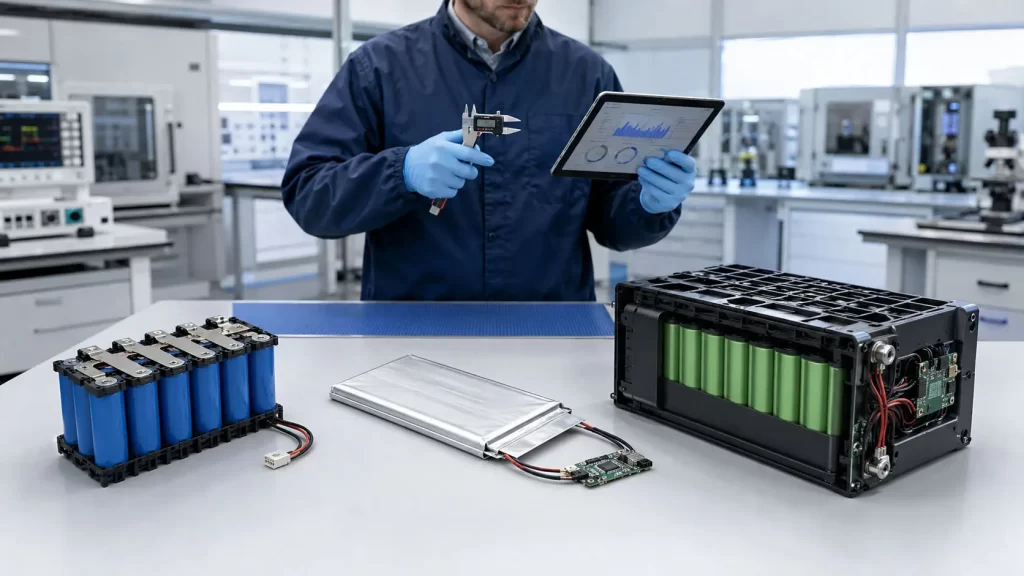
What is Li-ion Battery?
The term Li-ion is generally used for cylindrical or prismatic rechargeable lithium-ion batteries. Batteries in cylindrical sizes like 18650 and 21700 are common in battery packs since the battery packs come in a variety of sizes and discharge rates.
Typical applications include:
- Industrial equipment
- Service robots
- AGVs and AMRs
- Medical devices
- Portable lighting
- Bluetooth speakers
- Power tools
- POS terminals
- Consumer electronics
A Li-ion battery pack which is cylindrical can be connected in series to boost the voltage and in parallel to boost capacity. Also it may consist of a customized BMS, enclosure, connector and communication interface.
Main Advantages of Li-ion
- Good energy density
- Wide selection of cell models
- Flexible series-parallel configurations
- Suitable for medium- and high-power devices
- Established production and supply chain
- Available in high-discharge and fast-charging versions
Main Limitations of Li-ion
The cylindrical cells have fixed dimensions and so may not fit very small or odd-shaped product spaces. Other items needed for the battery pack include proper insulation, cell holders, welding, protection circuits, and structural support.
What Is a LiPo Battery?
LiPo, commonly known as lithium polymer battery, is typically a rechargeable lithium-ion battery that is contained in an aluminium-laminated flexible pouch. The term refers primarily to the cell format and design, and may be different from one manufacturer to another because of variations in the electrode chemistry used.
LiPo cells have many applications in the field of compact or lightweight products such as:
- Smart wearables
- Medical sensors
- Bluetooth headsets
- Portable speakers
- Beauty devices
- Tablets
- GPS trackers
- IoT devices
- Drones and RC products
- Compact consumer electronics
There are many thicknesses, widths and lengths of LiPo cells, which engineers can take advantage of when they have limited space available.
Main Advantages of LiPo
- Thin and lightweight structure
- Flexible dimensions
- Suitable for compact product designs
- Good use of irregular installation space
- Available in high-energy and high-discharge versions
- Can support customized wire and connector designs
Main Limitations of LiPo
Due to the lower rigidity of the pouch packaging compared to a cylindrical metal shell, pouch cells must be given suitable mechanical protection. The enclosure should be robust enough to guard the cell against being punctured, compressed, bent and having sharp internal features.
It is also important to allow for some reasonable tolerance and cell growth throughout its design life.
What Is a LiFePO4 Battery?
LiFePO4, also known as lithium iron phosphate, is a lithium-ion chemistry that is often chosen because of its long cycle life and thermal stability, making it suitable for applications that require a long lifespan and consistent performance over time.
Typical applications include:
- Industrial robots
- AGVs and AMRs
- Solar lighting
- Traffic signal systems
- Backup power
- Energy storage
- Cleaning equipment
- Industrial machinery
- Marine and outdoor systems
The nominal voltage of a LiFePO4 cell is lower than many standard lithium-ion batteries. To get the best from the series configuration and charger, it is important that it is tailored for the specific system, LiFePO4, and not copied from another lithium battery system.
Main Advantages of LiFePO4
- Long cycle-life potential
- Stable discharge characteristics
- Strong thermal stability
- Suitable for repeated daily cycling
- Practical for industrial and energy applications
- Available in cylindrical, prismatic and pouch formats
Main Limitations of LiFePO4
In general, LiFePO4 batteries offer less energy density than typical nickel-based lithium-ion batteries. The battery may be bigger or heavier, but still have the same amount of energy stored.
It also needs a suitable BMS and a charging profile. The charging equipment designed for another lithium chemistry should not be used without engineering verification.
Li-ion vs LiPo vs LiFePO4 Comparison
| Selection Factor | Li-ion | LiPo | LiFePO4 |
|---|---|---|---|
| Common format | Cylindrical or prismatic | Flexible pouch | Cylindrical, prismatic or pouch |
| Typical nominal cell voltage | About 3.6–3.7V | About 3.7V | About 3.2V |
| Energy density | High | High | Moderate |
| Shape flexibility | Moderate | High | Moderate |
| Weight efficiency | Good | Very good | Moderate |
| Cycle-life potential | Moderate to high | Moderate to high | High |
| High-power options | Available | Available | Available |
| Mechanical protection | Rigid cell shell | Requires external protection | Depends on cell format |
| Best fit | General portable and industrial devices | Thin, light or compact products | Long-life and frequent-cycle systems |
These values are typical comparisons. Actual performance will vary with the cell model, with the electrode formulation, temperature, discharge rate, charging method and depth of discharge.
How to Select the Right Battery Type
Choose Li-ion When:
- High energy is required within a practical volume
- Standard 18650 or 21700 cells fit the device
- The product has medium or high current demand
- A strong existing cell supply is important
- The battery uses a structured plastic or metal enclosure
Li-ion batteries are a good compromise for industrial equipment, robots, medical devices, lighting systems and portable electronics.
Choose LiPo When:
- The product must be thin or lightweight
- The battery compartment has limited or unusual dimensions
- Efficient use of internal space is critical
- A custom pouch-cell size is available
- The enclosure can provide sufficient mechanical protection
LiPo is particularly useful for wearables, compact medical devices, smart products, audio equipment and IoT devices.
Choose LiFePO4 When:
- Long cycle life is a high priority
- The battery will be charged and discharged frequently
- The system can accept additional size or weight
- Thermal stability is especially important
- The application is industrial, outdoor or stationary
LiFePO4 is commonly considered for robots, industrial equipment, solar systems and energy-storage applications.
Other Factors That Affect Battery Selection
Battery chemistry should not be selected by voltage and capacity alone. Engineers should also evaluate:
- Continuous and peak current
- Required runtime
- Charging time
- Operating temperature
- Battery dimensions
- Maximum weight
- Target cycle life
- Storage period
- Communication requirements
- Certification plans
- Replacement method
- Target unit cost
A small sized robot, for instance, could use a 21700 Li-ion pack because of its energy and power needs. A thin medical sensor can be the result in need of a custom LiPo pouch cell. If the product can handle the size and weight of the industrial robot, a frequently cycled one might be better served a LiFePO4 system.
BMS and Charger Compatibility
Each battery pack requires a protection and charging system designed for its chemistry and configuration. The BMS may provide:
- Overcharge protection
- Over-discharge protection
- Overcurrent protection
- Short-circuit protection
- Temperature monitoring
- Cell balancing
- State-of-charge monitoring
- Communication with the device
Charging voltage, cut-off voltage and balancing settings must match the selected cells. Changing from Li-ion to LiFePO4 usually requires changes to the BMS, charger and series configuration.
How GLOFLUX Supports Battery Selection
GLOFLUX provides custom Li-ion, LiPo and LiFePO4 battery pack solutions for OEM and ODM projects. The engineering team can evaluate the customer’s device requirements and recommend a suitable cell, pack configuration, BMS and mechanical structure.
Customers should provide:
- Device voltage
- Required capacity or runtime
- Continuous and peak current
- Maximum battery dimensions
- Operating temperature
- Charging method
- Communication requirements
- Target certification
- Estimated order volume
Prototype samples can then be produced for fit, runtime, charging and performance verification before mass production.
Conclusion
Li-ion provides a good combination of energy, power and availability. LiPo is suitable for thin, lightweight and space-constrained products. In cases where minimum size and weight are less critical than long cycle life and frequent daily usage, LiFePO4 is a popular choice.
The final choice should be made on the basis of the device's operating history. Helping OEM teams avoid incompatible chargers, wrong pack configurations and structural changes later in development comes from early cooperation with an experienced battery manufacturer.
Frequently Asked Questions
1. Which battery type has the highest energy density?
Li-ion and LiPo generally offer higher energy density than LiFePO4, but actual performance depends on the specific cell model and design.
2. Is LiPo safer than cylindrical Li-ion?
Safety depends on cell quality, BMS design, charging, mechanical protection and operating conditions. LiPo pouch cells require particular protection against puncture and compression.
3. Which battery is best for long cycle life?
LiFePO4 is commonly selected for projects prioritizing frequent cycling and long service life, although actual cycles vary with operating conditions.
4. Can the same charger be used for Li-ion and LiFePO4?
Generally, no. Their cell voltages and charging profiles differ, so the charger and BMS must match the selected chemistry.
5. Which battery should I use for a compact wearable device?
A custom LiPo pouch cell is often suitable because it can provide a thin, lightweight structure in dimensions matched to the device.
Talk to the Manufacturer
Resources & Insights
High Capacity Lithium Battery for Wearables: High-Voltage LiPo Cell Design
2026-10-19
Cylindrical Battery Packs for Laptops: 2S vs 3S vs 4S Battery Design
2026-10-19
Stage Lighting Battery Pack: Prevent Voltage Drop & LED Flicker
2026-10-19
Best Rechargeable Batteries for Smart Devices: Performance, Safety, and Selection Guide
2026-10-19


