


 Home /
 Li-ion Battery for POS Terminals: A Complete OEM Customization Guide


Table of Contents
- Why POS Terminals' Lithium-ion Batteries Require Customization
- Key Specifications for Li-ion Battery for POS Terminals
- Customization Options for Li-ion Battery for POS Terminals
- Safety and Compliance: Non-Negotiable
- Design Process of Custom Li-ion Batteries for POS Terminals
- Why Gloflux for Li-ion Batteries for POS Terminals
The global trend toward cashless transactions has intensified the need for more portable and robust POS terminals. Most modern POS terminals, used in retail, restaurants, logistics, and mobile payment solutions, incorporate high-performance rechargeable lithium batteries. For OEMs, the decision on which lithium-ion battery to use for POS terminals is an important design decision, rather than a straightforward sourcing decision. It directly impacts the terminal's performance, the user experience, and the maintenance costs over the terminal's lifecycle.
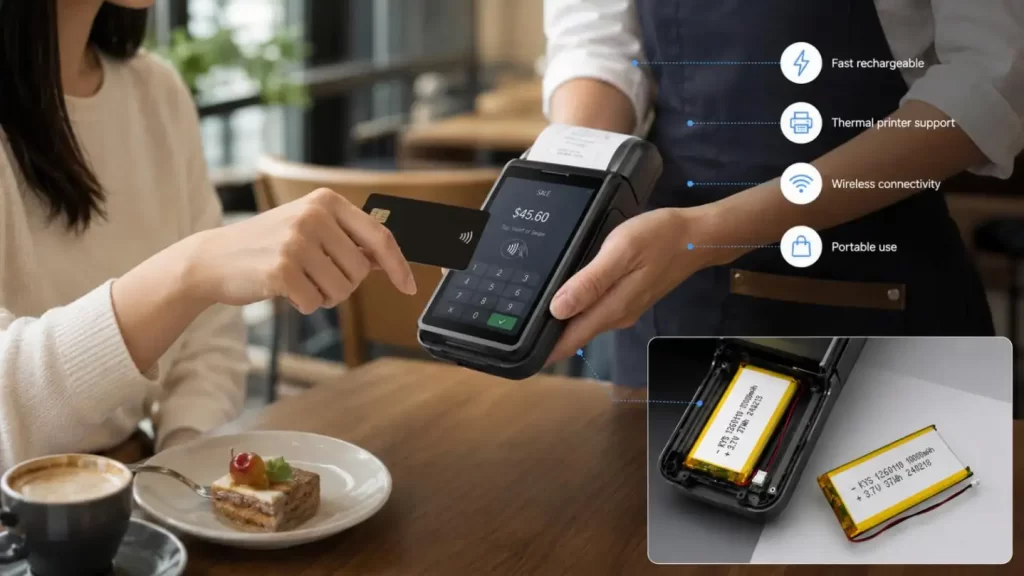
This article provides an overview on the design parameters, customization, and compliance for the POS terminal lithium-ion battery of choice for OEMs.
Why POS Terminals' Lithium-ion Batteries Require Customization
Most commercially available batteries cannot be integrated into POS terminals. OEMs of POS terminals frequently face issues of insufficient POS terminal internal space, inadequate battery runtimes, slow battery recharge times, and safety compliance issues. Customized lithium-ion batteries for POS Terminals provide solutions to all of these issues.
•Modern POS Terminals require high levels of battery performance: Retail employees use handheld POS Terminals throughout the day, battery reliability becomes critical.
•POS Terminals can have vastly different architectures: Some POS Terminals may have large display screens, cameras to capture barcodes, and even cellular and wireless connectivity along with Bluetooth and thermal printing features, all of which have different power requirements.
Internal space for battery packs is limited: Compared to commercially available cylindrical batteries, such as the 18650 or 21700, lithium polymer batteries can be designed into thin, flexible, and high-capacity packs.
Key Specifications for Li-ion Battery for POS Terminals
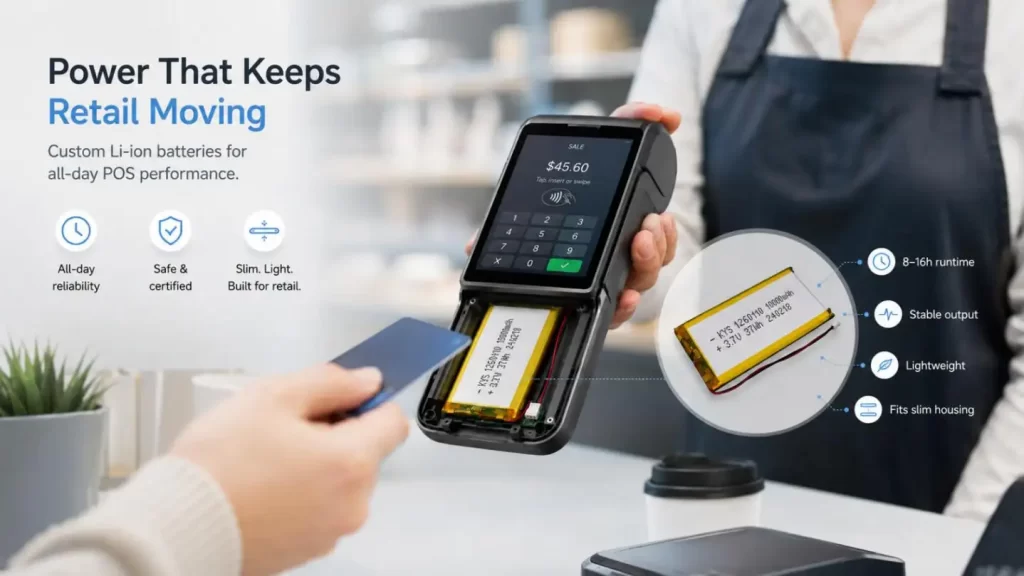
OEMs should consider the following specifications when selecting a Li-ion battery for their POS terminals.
•Nominal Voltage: BMS for POS terminals typically incorporates a single lithium-ion cell of 3.7 V. A few terminals rely on 7.4V battery packs. The voltage has to satisfy the requirements of the device.
•Capacity (mAh): The battery of a POS terminal can have the capacity in the range of 2,600mAh-10,000mAh. Capacity is determined by the power requirements of the device and the expected length of time that the terminal will be in use. Higher capacity batteries have longer operational time. Typically a device will have an expected usage of about 8 to 16 hours of continuous use.
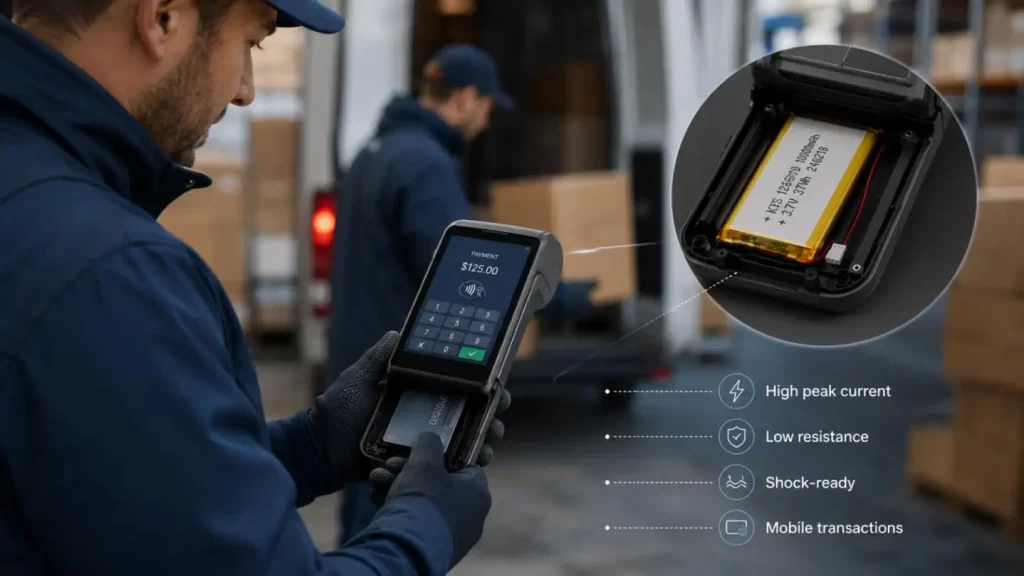
•Internal Resistance: The internal resistance of the battery is expected to be low. For example, a resistance of 30 mΩ is desirable because it provides better performance for the battery and less heat generation.
•Discharge Rate: A few POS terminals may demand a high peak current for operation. A Li-ion battery for POS terminals can be designed to operate at a discharge rate of 20C.
Customization Options for Li-ion Battery for POS Terminals
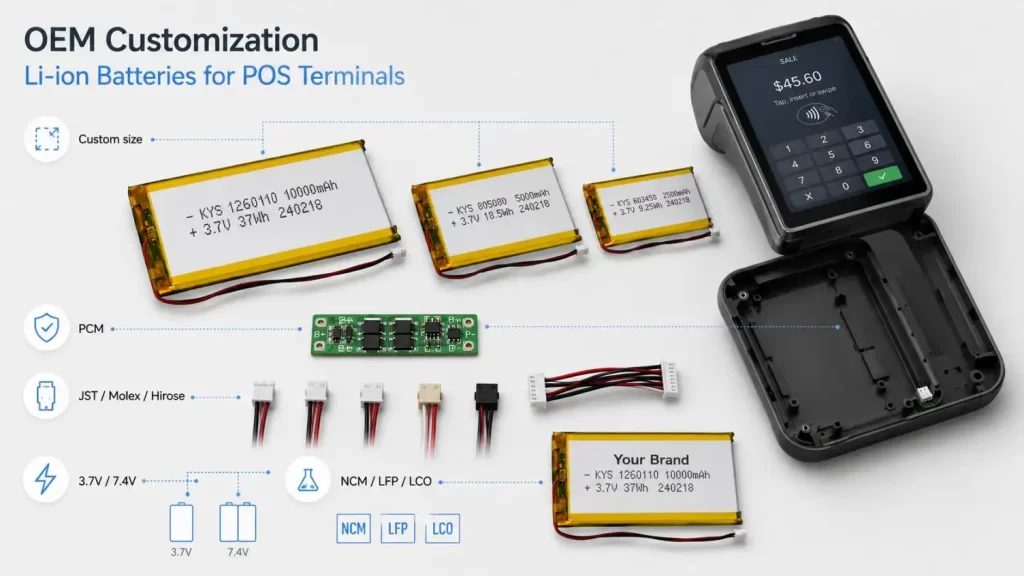
Every aspect of a Li-ion battery for POS terminals can be customized to suit the requirements of a particular device.
•Dimensions and Form Factor: Because LiPo pouch cells can be designed with a high level of shape customization, a design choice can be made that allows battery placement in a way that optimizes use of a design space. Unlike cylindrical battery designs, this can result in a POS terminal that is slimmer and lighter, with no loss of usability.
•Capacity and Voltage: Battery capacity and the voltage design can be tailored to customer requirements as a function of power needs and can be designed with single or multiple cells.
•Protection Circuit Module (PCM): Our Li-ion battery customized for POS terminals integrates a protection board featuring overcharge, overdischarge, overcurrent, and short-circuit controls. These protection features minimize the risk of failure and maximize the battery cycle.
•Connectors and Wiring: Battery Packs can utilize variety connectors (Molex, JST, Hirose, etc) or custom wiring harnesses that can be configured to the specific layout of any device.
•Chemical Systems: OEMs have the options of NCA, NCM, LFP, and LCO chemistries. Different chemistries allow for a number of energy densities and cycle counts which can fit specific cost and thermal stability requirements.
•Branding and Labeling: Custom battery packs allow the OEM logo and model number to be branded directly onto the packs for a more professional look, as well as regulatory markings.
Safety and Compliance: Non-Negotiable
Unquestionably, a POS terminal's Li-ion battery must be safe and meet International Safety and Transport Regulations.
•IEC 62133: The international standard of safety for portable secondary lithium batteries and the safety of a battery pack and portable power bank from an electrical, mechanical and a chemical standpoint.
•UN38.3: This standard covers the safety of lithium batteries in transport, and includes a series of tests for a battery pack a low pressure test, thermal cycling, vibrations and shock, as well as external short circuit, impact, overcharge, and forced discharge.
•Other Certifications: Other markets may require compliance for a POS terminal's Li-ion battery with UL2054, UL1642, CE, RoHS, KC, CB, and PSE.
A reliable battery will have mechanical and electrical safety and stability compliance throughout its production. Meeting these criteria will give a manufacturer a competitive advantage.
Design Process of Custom Li-ion Batteries for POS Terminals
The process of customization involves different steps of an engineering process.
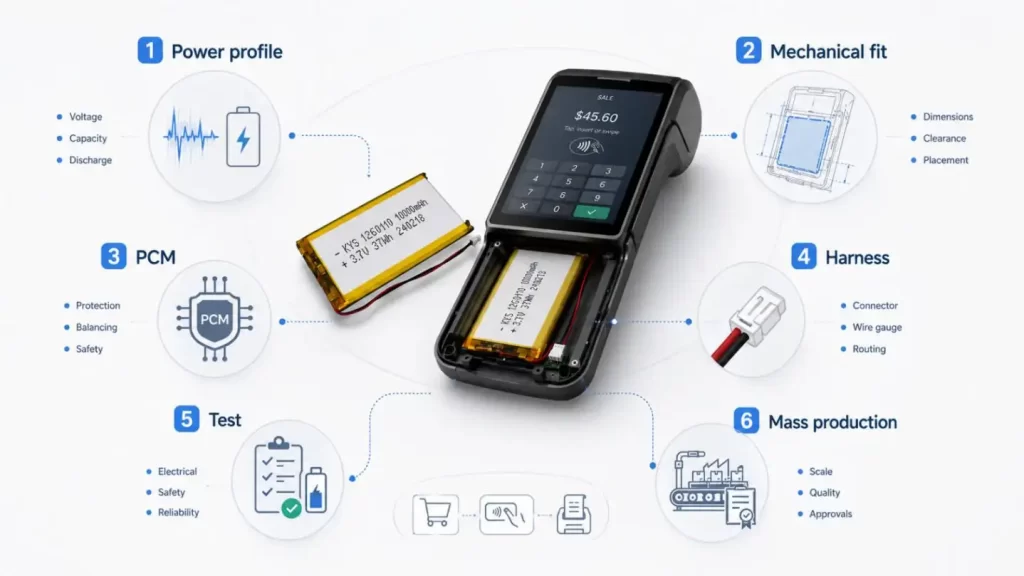
Step 1 - Defining electrical parameters: The power profile of the POS terminal determines the operating voltage and the methods of charging. The POS terminal also determines the battery's capacity, peak, and continuous current.
Step 2 - Mechanical Design: In this step, the design of the battery begins, focusing on the terminal's cavity and the size of the POS terminal with the maximal usable capacity.
Step 3 - Protection Circuit Design: A protection circuit module (PCM) is designed and built at this step. The protection circuit module provides protection for charging/discharging, overcurrent, and short-circuit events.
Step 4 - Design Harness and Select Connectors: At this step a harness is designed and connectors and wires are selected. The harness and connectors/wires are needed to provide an electrical connection from the battery to the POS terminal hardware.
Step 5 - Manufacture Battery and Test: in this phase, we manufacture a sample battery, and perform formation cycling and aging on the sample battery. We also conduct dimensional, insulation resistance, and leakage tests on the sample battery.
Step 6 - Manufacture Battery in Bulk and Regulatory Approvals: In this step we apply all the design and construct the battery in bulk. The battery is manufactured as per the standards outlined in UN38.3 and IEC 62133.
Why Gloflux for Li-ion Batteries for POS Terminals
Gloflux's laminated pouch architecture and their stacked lithium polymer battery design offers an edge over their competitors. The batteries offer a consistent voltage with an extremely low self-discharge. Other advantages include:
•Best Use of Space: Compared to a cylindrical battery, a flat lithium polymer battery offers a higher battery density. Manufacturers have the ability to design batteries to fit the allotted space within the POS terminal.
•Multi-Level Safety Protection: Each battery has internal protection circuits for overcharge, overdischarge, overcurrent and short-circuits to ensure safe use in the most difficult retail environments.
•Flexible OEM Customization: Comprehensive customization is offered by Gloflux, covering the protection PCBs, wires, terminal connectors, dimensions, capacity, and chemical systems in accordance with the customer's needs.
•End-to-End Compliance: All production processes are in accordance with the IEC 62133 and UN38.3 regulations, and many tests such as formation cycling and aging, and quality assessment are performed throughout the production process.
•Proven Reliability: Gloflux batteries offer the real rated capacity as designed and a long cycle life to deliver a solution with the needed longevity and with high reliability over many hundreds of charge-discharge cycles.
Making the Best Decision
When determining the correct Li-ion battery for POS terminals, it is essential to weigh different factors such as safety and cost. It is important to analyze POS terminal battery options for understanding a partner's design and engineering capabilities.
Li-ion batteries used for designing custom POS terminals improve safety and enhance runtime and reliability. It also helps the manufacturer's space design. As a result, manufacturers can develop innovative POS terminals that address the increasing market needs.
Frequently Asked Questions
Q1. What safety features are important in a custom POS battery?
A good custom POS battery will include a protection circuit module with charging, discharging, current, and short-circuit protections built in.
Q2. Is it possible to make a custom battery shape and size for my POS device?
Yes. Lithium polymer pouch cells are flexible in that OEMs can determine sizing along with the thickness, and can even offer curves.
Q3. What safety certifications are needed for a POS terminal battery?
POS terminal compliant Li-ion batteries should be certified to IEC 62133 for safety, UN 38.3 for transport. Additional certifications of UL, CE, RoHS, and/or KC may be required for the target markets.
Q4. How does the capacity of a battery effect the functionality of a POS terminal?
The larger the capacity, the longer the battery runs. An example would be a 10,000 mAh battery running seamless payment transactions for an entire day, whereas a battery with less capacity would run for only a few hours.
Q5. What are the differences between the types of batteries used for POS devices: LiPo pouch cells and cylindrical cells?
The main differences come down to size and weight of the battery. LiPo pouch cells are ideal for slim design POS systems, while cylindrical cells are larger, more cost effective, and take up more space.
Talk to the Manufacturer
Resources & Insights
High Capacity Lithium Battery for Wearables: High-Voltage LiPo Cell Design
2026-10-19
Cylindrical Battery Packs for Laptops: 2S vs 3S vs 4S Battery Design
2026-10-19
Stage Lighting Battery Pack: Prevent Voltage Drop & LED Flicker
2026-10-19
Best Rechargeable Batteries for Smart Devices: Performance, Safety, and Selection Guide
2026-10-19


