


 Home /
 7.4V 1200mAh 30C LiPo Battery for Quadcopters and RC Truck Models


Table of Contents
- 1. What Does the 2S 7.4V Configuration Mean?
- 2. Understanding the 1200mAh Capacity
- 3. Strong 30C Discharge Performance
- 4. Compact and Lightweight Battery Design
- 5. Applications for Quadcopters and FPV Drones
- 6. Applications for RC Trucks and Cars
- 7. Custom Connector and Cable Options
- 8. OEM and ODM Battery Customization
- 9. Charging and Storage Guidelines
- 10. Choosing a Reliable RC Model Battery
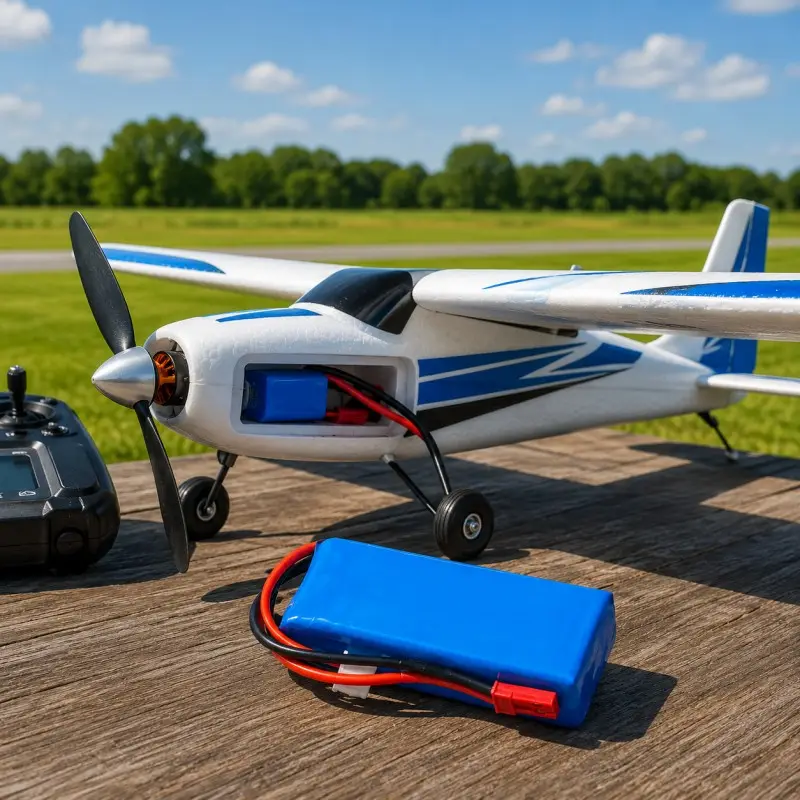
Remote-controlled models require a compact battery that can deliver strong current without adding excessive weight. Whether the equipment is a quadcopter, FPV drone, RC truck, racing car, or small model boat, the power source directly affects acceleration, control response, operating time, and overall performance.
The 7.4V 1200mAh 30C LiPo battery is designed for remote-controlled devices that need a practical balance between capacity, size, weight, and discharge capability. Its 2S configuration provides a nominal voltage of 7.4V, while the 30C discharge rate supports demanding motors and electronic systems.
This battery can also be customized with different connectors, wire lengths, dimensions, labels, and packaging for OEM and ODM model projects.
1. What Does the 2S 7.4V Configuration Mean?
A 2S LiPo battery contains two lithium polymer cells connected in series. Each cell has a nominal voltage of approximately 3.7V, creating a total nominal voltage of 7.4V.
When fully charged, a standard LiPo cell reaches approximately 4.2V. Therefore, a fully charged 2S battery can reach approximately 8.4V. Users should always choose a charger and electronic system that are compatible with a 2S lithium polymer battery.
The 7.4V configuration is commonly used in small and medium-sized remote-controlled models because it offers more power than a single-cell battery while remaining relatively compact and lightweight.
2. Understanding the 1200mAh Capacity
Battery capacity indicates how much electrical energy the battery can store. A 1200mAh battery provides a suitable energy level for many lightweight quadcopters, RC trucks, racing cars, and other compact models.
Actual operating time depends on several factors, including:
- Motor power and efficiency
- Average current consumption
- Vehicle or aircraft weight
- Driving or flying speed
- Propeller, wheel, or gear configuration
- Terrain and weather conditions
- Battery age and operating temperature
A higher-capacity battery may provide longer runtime, but it is usually larger and heavier. For flying models, additional battery weight may reduce maneuverability and increase motor load. The selected capacity should therefore match the model’s battery compartment, weight limit, and power requirements.
3. Strong 30C Discharge Performance
The discharge rate describes how quickly a battery can safely deliver current. A 30C battery is designed to provide stronger current output than a low-rate battery of the same capacity.
For RC trucks and racing models, this discharge capability supports rapid acceleration, climbing, turning, and operation on demanding terrain. For quadcopters and FPV drones, it helps provide responsive motor output during takeoff, climbing, directional changes, and stabilization.
Stable discharge performance is especially important when several motors operate at the same time. A suitable battery can help reduce noticeable voltage drops and maintain more consistent model performance under changing loads.
The battery’s actual current capability should always be evaluated together with the motor, electronic speed controller, connector, wiring, and overall power system.
4. Compact and Lightweight Battery Design
Installation space is often limited in quadcopters, RC vehicles, and small robotic devices. The battery must fit securely without interfering with moving parts, cooling, wiring, or the center of gravity.
Lithium polymer cells can be manufactured in a relatively flat and lightweight structure, making them suitable for compact model products. A properly selected battery can provide the required energy while helping the aircraft or vehicle maintain balanced handling.
Before ordering a custom battery, customers should provide the maximum available length, width, and thickness. Information about the preferred battery weight and installation direction is also helpful.
Selecting a battery only by voltage and capacity may result in dimensional or weight compatibility problems.
5. Applications for Quadcopters and FPV Drones
Quadcopters use multiple motors that continuously adjust their speed to control altitude, direction, and stability. These frequent motor changes require a battery with dependable power output.
The 7.4V 1200mAh 30C LiPo battery may be used in compatible:
- Small quadcopters
- FPV training drones
- Racing drones
- Aerial photography models
- Educational multirotor platforms
- Custom unmanned aircraft prototypes
Battery compatibility depends on the aircraft’s voltage range, motor specifications, electronic speed controllers, weight capacity, dimensions, and connector type.
For FPV models, the battery may also power compatible cameras, transmitters, receivers, lights, and other onboard electronic components.
6. Applications for RC Trucks and Cars
RC trucks and racing cars frequently experience sudden changes in current demand. Starting, accelerating, climbing, braking, and driving across rough surfaces can place a heavy load on the power system.
A 30C high-discharge LiPo battery can support responsive performance in compatible:
- RC trucks
- Off-road vehicles
- Racing cars
- Rock crawlers
- Short-course trucks
- Drift models
- Educational vehicle platforms
The compact 2S battery configuration is useful for models that require a practical combination of speed, runtime, and manageable weight.
The battery compartment should hold the pack securely. Loose batteries may move during operation, damage the wires, affect vehicle balance, or create additional impact risks.
7. Custom Connector and Cable Options
Different RC products may use different main discharge connectors and balance plugs. Even when the voltage and capacity are correct, an unsuitable connector can prevent proper installation.
Available customization options may include:
- Main power connector type
- Balance connector specification
- Wire length and thickness
- Cable outlet direction
- Connector polarity
- Heat-shrink color
- Product label design
- Brand logo and model number
- Individual or bulk packaging
Customers should provide clear connector images, technical drawings, or physical samples when possible. Connector polarity must be carefully confirmed before production because reverse polarity may damage the battery or connected equipment.
8. OEM and ODM Battery Customization
Model manufacturers and electronics brands may require a battery developed around a specific product design. Custom battery services allow the electrical and mechanical specifications to be adjusted according to the application.
A custom project may involve changes to battery dimensions, capacity, discharge performance, connector configuration, cable length, label content, and packaging.
Before battery development begins, the supplier may request information such as:
- Required voltage and capacity
- Maximum continuous current
- Peak discharge current
- Available installation space
- Target operating time
- Connector and wire requirements
- Equipment operating temperature
- Estimated order quantity
Sample production and equipment testing are recommended before mass production. Testing helps verify installation, runtime, motor performance, charging compatibility, temperature rise, and connector reliability.
9. Charging and Storage Guidelines
A balance charger designed for 2S LiPo batteries should be used. The charging voltage and current must match the battery manufacturer’s recommendations.
The battery should not be charged when it is swollen, leaking, punctured, overheated, or physically damaged. Charging should take place in a suitable area away from flammable materials.
After operation, the battery should be allowed to cool before charging. For extended storage, it should be maintained at an appropriate storage voltage rather than being kept fully charged or deeply discharged.
Users should avoid short circuits, reverse polarity, excessive impact, water exposure, overcharging, over-discharging, and operation outside the recommended temperature range.
10. Choosing a Reliable RC Model Battery
The 7.4V 1200mAh 30C LiPo battery provides a flexible rechargeable power solution for quadcopters, FPV drones, RC trucks, racing cars, boats, and other remote-controlled products.
Its 2S voltage configuration, practical capacity, strong discharge performance, and compact structure make it suitable for a wide range of compatible models. Custom connectors, wires, dimensions, labels, and packaging also allow the battery to support different OEM and ODM requirements.
The best battery is not simply the model with the highest capacity or discharge rating. Voltage, current demand, installation space, battery weight, connector compatibility, charging method, and expected runtime should all be evaluated together. A properly matched and tested LiPo battery can improve power delivery, model responsiveness, installation convenience, and overall operating reliability.
Talk to the Manufacturer
Resources & Insights
High Capacity Lithium Battery for Wearables: High-Voltage LiPo Cell Design
2026-10-19
Cylindrical Battery Packs for Laptops: 2S vs 3S vs 4S Battery Design
2026-10-19
Stage Lighting Battery Pack: Prevent Voltage Drop & LED Flicker
2026-10-19
Best Rechargeable Batteries for Smart Devices: Performance, Safety, and Selection Guide
2026-10-19


