


 Home /
 Who Is a Reliable Custom Lithium Battery Pack Manufacturer in China?


Table of Contents
- What Makes a Lithium Battery Manufacturer Reliable?
- 2. Custom BMS and Protection Design
- 3. Flexible Mechanical Customization
- 4. Prototyping Before Mass Production
- 5. Quality Control and Battery Testing
- 6. Certification and Transportation Support
- Why Work With GLOFLUX?
- Information to Send for a Custom Battery Quote
- Conclusion
- Frequently Asked Questions
Choosing a reliable custom lithium battery pack manufacturer from China involves more than simply comparing prices and picking a supplier from a list on the internet. The battery directly impacts the product runtime, safety, reliability, certification, and market launch for OEMs, product developers, engineers, and purchasing teams.
The qualified manufacturer should be able to provide the support for the entire development process, from battery chemistry, cell selection, BMS design, prototyping, testing, support for certification and mass production.
The GLOFLUX offers developed custom lithium battery pack solutions for medical devices, industrial equipment, robots, POS terminals, Bluetooth speakers, smart wearables, portable lighting, IoT devices, and other electronic devices. By not providing only standard battery models, the engineering team can create battery packs to fit the requirements of the device.
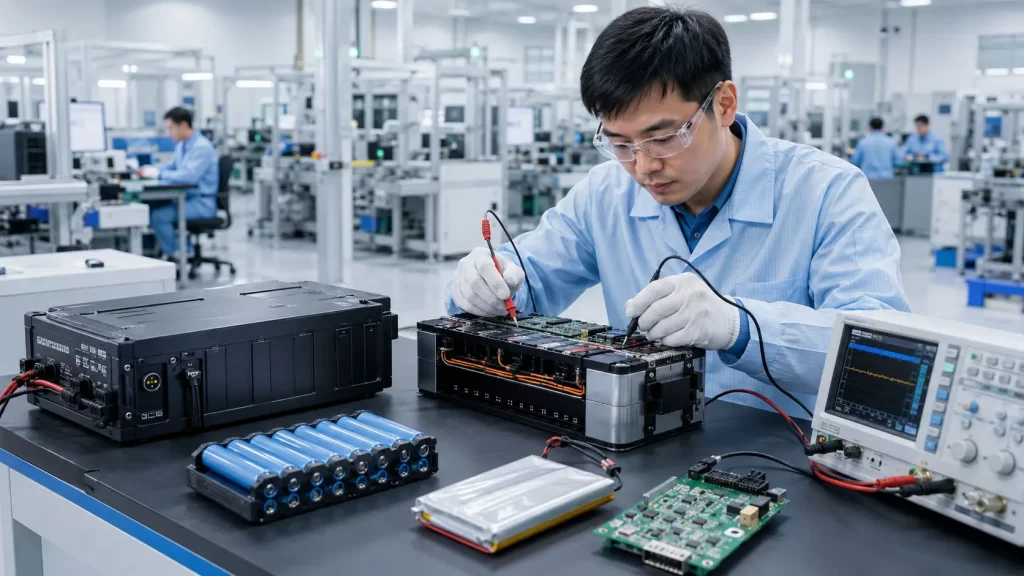
What Makes a Lithium Battery Manufacturer Reliable?
The supplier should exhibit good engineering skills, a controlled manufacturing procedure, communication and quality. Purchasers should consider the manufacturer in a number of significant ways.
1. Battery Engineering Capabilities
The first step in custom battery development is to know the electrical and mechanical specifications for the device. A pro should be able to assess:
- Required voltage and capacity
- Continuous and peak discharge current
- Charging voltage and charging current
- Available installation space
- Operating temperature
- Expected runtime
- Target cycle life
- Connector and wire requirements
- Communication protocol
- Safety and certification requirements
The manufacturer should not simply recommend the largest available battery. It should balance runtime, size, weight, discharge performance, charging time, safety, and project cost.
GLOFLUX supports custom battery configurations using lithium-ion, lithium polymer, and LiFePO4 technologies. Different cell formats and chemistries can be evaluated according to the application.
2. Custom BMS and Protection Design
The manufacturer shouldn't just say that the battery should be the largest size available. It should also be a compromise between runtime, size, weight, discharge performance, charging time, safety and project cost.
Depending on the project, a custom BMS may include:
- Overcharge protection
- Over-discharge protection
- Overcurrent protection
- Short-circuit protection
- Temperature monitoring
- Cell balancing
- State-of-charge monitoring
- Fuel-gauge functions
- CAN, UART, RS485, I²C or SMBus communication
In the case of medical machines, robots, industrial systems, and smart devices, communication and monitoring capabilities can be as critical as voltage and capacity. These should therefore be validated at the early design phase.
3. Flexible Mechanical Customization
The battery pack will need to be tailored to fit the space within the customer's product. This is particularly focused on portable electronic devices, medical devices, wearables, robots, handheld terminals and small IoT devices.
A capable Chinese battery manufacturer should support customization of:
- Battery dimensions
- Cell arrangement
- Plastic enclosure
- Metal enclosure
- Heat-shrink packaging
- Connector model
- Wire length and gauge
- Charging and discharge ports
- Labels, branding, and packaging
Customers can provide a 2D drawing, 3D model, battery compartment dimensions, original battery sample, or device prototype. Engineers can then assess whether an existing cell configuration is suitable or whether a new battery structure is required.
4. Prototyping Before Mass Production
Custom battery development should always include sample verification before a large production order. Prototypes allow the customer to test physical fit, operating time, charging compatibility, output performance, temperature behavior, and communication functions.
A practical development process generally includes:
- Collection of technical requirements
- Battery chemistry and cell selection
- Electrical and structural design
- Specification confirmation
- Prototype production
- Customer testing and approval
- Certification preparation
- Pilot production
- Mass production and quality inspection
Customers can submit a 2D drawing, 3D model, battery compartment dimensions, sample of the original battery, or a prototype of the device. This allows engineers to determine if an existing cell configuration is viable, or if a new battery structure is needed.
5. Quality Control and Battery Testing
Sample Testing should be a part of any custom battery development prior to a mass production order. The customer can try out physical fit, operating time, charging compatibility, output performance, temperature behavior, and communication functions using prototypes.
Typical inspections may include:
- Cell voltage and internal resistance testing
- Cell capacity grading and matching
- Battery dimension inspection
- Charging and discharging tests
- Protection circuit verification
- Connector polarity inspection
- Cycle-life evaluation
- High- and low-temperature testing
- Drop, vibration, and mechanical testing
- Aging tests before shipment
Testing requirements vary according to the battery chemistry, application, voltage, structure, and destination market. Buyers should request a quality-control plan that matches their actual project instead of relying only on general factory statements.
6. Certification and Transportation Support
Lithium batteries are regulated products. The documents and testing required depend on the battery design, application, transportation method, and target market.
Projects may involve:
- UN38.3
- IEC 62133
- UL 2054
- CE
- RoHS
- MSDS
- IEC 62619
- Transport test summaries
Not all certifications are applicable to all batteries. A good manufacturer should assist the customer to determine the relevant requirements during development. Planning for certification should start early in order to consider changes in cells, BMS, enclosure or battery configuration that may impact the scope of testing.
Why Work With GLOFLUX?
GLOFLUX is a Chinese lithium battery manufacturer offering battery OEM/ODM products to foreign client. It provides cell selection, pack configuration, BMS integration, enclosure design, prototype development, testing and support for mass production.
Available customization options include:
- Lithium-ion, LiPo, and LiFePO4 battery packs
- Cylindrical and pouch-cell configurations
- High-energy-density and high-discharge solutions
- Wide-temperature battery packs
- Smart BMS and communication functions
- Customized connectors, cables, housings, and labels
- Replaceable and rechargeable battery modules
- Prototype and volume-production support
The most suitable battery solution depends on the device rather than a standard catalogue model. Customers are therefore encouraged to provide the product’s voltage, capacity, current, dimensions, operating environment, charging method, and estimated order quantity.
Information to Send for a Custom Battery Quote
To receive an accurate technical recommendation and quotation, provide as much of the following information as possible:
- Nominal voltage
- Required capacity or operating time
- Continuous working current
- Maximum or peak current
- Maximum battery dimensions
- Connector and cable requirements
- Charging input
- Operating temperature
- Communication requirements
- Target certifications
- Prototype quantity
- Estimated annual demand
If some parameters are not yet available, GLOFLUX can review the device specifications and help determine a practical starting configuration.
Conclusion
A process of engineering support, transparent communication, controlled production, proper testing and certification guidance should be offered by the reliable custom lithium battery pack manufacturer, not a low price point.
GLOFLUX is an ideal solution for OEMs who wish to create medical, industrial, portable, robotic or smart electronic products, providing custom battery development from conception to prototype verification to mass production. Early technical communication minimizes redesign risk, contributes to battery compatibility and aids in a smoother product launch.
Frequently Asked Questions
1. Can GLOFLUX develop a battery from my product drawing?
Yes. Customers can provide battery compartment dimensions, device drawings, electrical requirements, or an original battery sample for engineering evaluation.
2. What information is required to customize a lithium battery pack?
The main information includes voltage, capacity, working current, peak current, dimensions, connector, charging method, operating temperature, and estimated quantity.
3. Can I order samples before mass production?
Yes. Prototype samples can be produced for fit, runtime, charging, communication, and performance verification before moving to volume production.
4. Which battery chemistries can be customized?
Depending on the application, GLOFLUX can evaluate lithium-ion, lithium polymer, and LiFePO4 solutions in cylindrical, pouch, or assembled module formats.
5. Can GLOFLUX support battery certification?
GLOFLUX can support certification planning and testing preparation based on the battery design, product application, transportation method, and destination market.
Talk to the Manufacturer
Resources & Insights
High Capacity Lithium Battery for Wearables: High-Voltage LiPo Cell Design
2026-10-19
Cylindrical Battery Packs for Laptops: 2S vs 3S vs 4S Battery Design
2026-10-19
Stage Lighting Battery Pack: Prevent Voltage Drop & LED Flicker
2026-10-19
Best Rechargeable Batteries for Smart Devices: Performance, Safety, and Selection Guide
2026-10-19


