


 Home /
 Custom Rechargeable Lithium Battery for Bluetooth Speakers and Portable Audio Devices


Table of Contents
- Why Bluetooth Speakers Need a Custom Battery
- Selecting the Correct Battery Voltage
- Matching Capacity to Playback Requirements
- Current Output and Audio Performance
- Lithium-Ion or Lithium Polymer Battery
- Customized Size, Connector, and Wiring
- Battery Protection and Safety Design
- Typical Applications
- What Information Should Be Provided?
- Conclusion
- Frequently Asked Questions
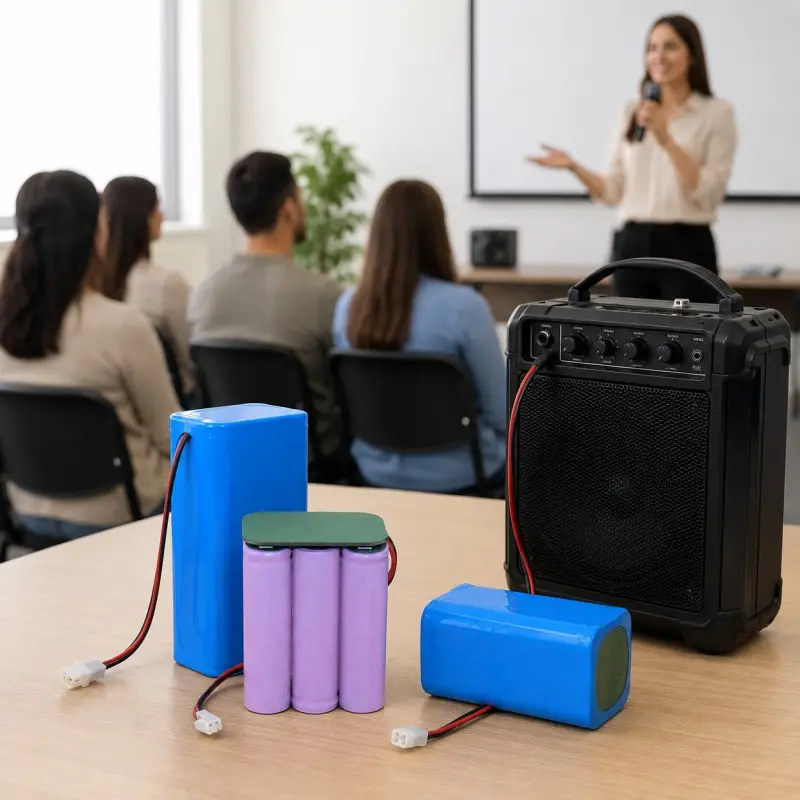
Bluetooth speakers and portable audio products are expected to deliver stronger sound, longer playback time, compact dimensions, and convenient wireless operation. Achieving all four goals depends heavily on the battery system inside the device. A standard battery may work for an early prototype, but many commercial audio products require a custom lithium battery that matches the enclosure, amplifier, charging circuit, and expected operating time.
A custom lithium battery for Bluetooth speakers can be designed with the required voltage, capacity, dimensions, connector, wiring, protection circuit, and packaging structure. This allows audio equipment manufacturers to develop a power solution around the product rather than modifying the entire speaker around an available battery.
Why Bluetooth Speakers Need a Custom Battery
Portable speakers contain several components competing for limited internal space. The enclosure must accommodate speaker drivers, an amplifier board, charging ports, wireless modules, control buttons, acoustic chambers, wiring, and the battery itself.
Using an unsuitable battery may create several problems. The battery may be too large for the compartment, too weak for peak audio demand, incompatible with the charger, or unable to provide the required playback time. Poor wire routing or an incorrect connector can also make assembly difficult.
A custom battery solves these issues by matching the actual mechanical and electrical requirements of the speaker. The battery can be shaped and configured according to the available installation space while maintaining the correct output voltage and current performance.
Selecting the Correct Battery Voltage
Battery voltage must match the speaker’s amplifier and charging architecture. Small Bluetooth speakers may use a single-cell 3.7V lithium polymer battery, while larger portable audio systems often use 7.4V, 11.1V, or other multi-cell configurations.
A 3.7V battery normally reaches approximately 4.2V when fully charged. A 7.4V two-cell battery pack generally reaches 8.4V at full charge. The charging circuit must be designed for the selected battery configuration.
Installing a battery with the wrong voltage can cause unstable operation or damage the device. For this reason, voltage selection should be based on the amplifier input, charging circuit, power-conversion design, and maximum audio output rather than the physical size of the speaker alone.
Matching Capacity to Playback Requirements
Battery capacity is normally measured in milliampere-hours. A larger capacity can provide longer operating time, but actual playback duration depends on the complete audio system.
Speaker power, listening volume, bass output, amplifier efficiency, Bluetooth communication, decorative lighting, displays, and standby current all affect battery consumption. A speaker played at maximum volume will usually operate for less time than the same device used at moderate volume.
During development, engineers should determine the target playback time and measure the speaker’s average and maximum current consumption. The battery capacity can then be selected more accurately. Prototype testing inside the actual device remains essential because calculations alone cannot reproduce every operating condition.
Current Output and Audio Performance
Audio equipment does not draw a perfectly constant current. Strong bass, high volume, startup operation, and additional electronic functions may create brief periods of higher demand.
A battery with insufficient discharge capability may cause sound distortion, unexpected shutdowns, device restarts, or activation of the protection circuit. Capacity therefore should not be the only selection factor.
The battery cells, nickel connections, lead wires, connector terminals, and protection board must all support the speaker’s continuous and peak current requirements. For higher-powered portable audio systems, the discharge design should be confirmed under maximum volume and full-feature operation.
Lithium-Ion or Lithium Polymer Battery
Both lithium-ion and lithium polymer batteries can be used in Bluetooth speakers.
Lithium polymer pouch cells are often selected for compact or thin audio products because their length, width, and thickness can be adjusted within practical manufacturing limits. Their flat structure can make better use of irregular internal spaces.
Cylindrical lithium-ion cells may be suitable for larger speakers where the enclosure provides enough room. They can offer a robust structure and are available in widely used formats such as 18650 and 21700.
The most suitable option depends on the available space, required capacity, current demand, weight target, mounting method, and production volume. The battery manufacturer should review the complete project rather than recommending a cell type from voltage and capacity alone.
Customized Size, Connector, and Wiring
Mechanical compatibility is especially important for portable audio products. A custom battery pack may include specified dimensions, foam padding, insulation materials, cable outlet position, and external wrapping.
Connector customization can include the connector housing, terminal type, wire gauge, wire length, pin sequence, and polarity. Similar-looking connectors may use different wiring arrangements, so the polarity must be confirmed before production.
For replacement battery projects, the original battery sample is often the most useful reference. Clear photos, compartment dimensions, connector details, and wire sequence can also help the manufacturer evaluate compatibility.
Battery Protection and Safety Design
A custom speaker battery can include a protection circuit designed for the application. Common functions may include overcharge, over-discharge, overcurrent, and short-circuit protection. Multi-cell packs may also require voltage monitoring and balancing.
Temperature sensing can be added where the charging system or product design requires it. However, the protection circuit is only one part of the complete safety system. Cell selection, charging control, insulation, enclosure design, heat dissipation, assembly quality, and production testing are also important.
The protection board must be matched to the speaker’s peak current. If the overcurrent threshold is too low, the device may shut down during high-volume playback. If it is set incorrectly, the battery may not provide the intended protection.
Typical Applications
Custom lithium batteries can be developed for portable Bluetooth speakers, wireless desktop speakers, voice amplifiers, teaching systems, tour-guide equipment, compact PA systems, portable karaoke devices, outdoor sound systems, and rechargeable multimedia speakers.
They are also suitable for replacement battery programs, product upgrades, and OEM or ODM audio projects. Each application may require a different combination of voltage, capacity, size, discharge capability, connector, and protection functions.
What Information Should Be Provided?
To begin a custom battery project, the customer should provide the required voltage, expected capacity, target playback time, maximum continuous current, peak current, charging method, available installation space, connector details, wire length, and operating environment.
A device sample, original battery, enclosure drawing, or three-dimensional model can make the development process more efficient. The proposed battery should then be tested inside the actual audio product before mass production.
Important tests include charging performance, playback time, high-volume operation, temperature rise, low-battery shutdown, connector reliability, standby consumption, and repeated charge-discharge cycling.
Conclusion
A custom lithium battery is more than a power source for a Bluetooth speaker. It is an integrated part of the audio product’s mechanical structure, electrical system, operating time, and user experience.
By matching the voltage, capacity, current output, dimensions, connector, protection circuit, and charging system, manufacturers can reduce installation problems and improve product reliability. Careful sample evaluation and device-level testing are essential before final approval, especially for products requiring long playback time or high audio output.
Frequently Asked Questions
1. Can the voltage and capacity be customized?
Yes. Voltage, capacity, and cell configuration can be developed according to the speaker’s electrical design, available space, and required playback time.
2. Which battery type is better for Bluetooth speakers?
Lithium polymer batteries are often suitable for compact and thin designs, while cylindrical lithium-ion cells may work well in larger enclosures. The final choice depends on space, current, capacity, and structural requirements.
3. Can the connector and wire length be changed?
Yes. Connector type, wire gauge, cable length, polarity, pin arrangement, and cable outlet direction can be customized for the device.
4. Does the battery include a protection circuit?
A suitable protection circuit can be integrated according to the battery configuration, charging current, discharge current, and safety requirements.
5. What is needed to develop a speaker battery sample?
The battery manufacturer normally needs the voltage, capacity, current demand, compartment dimensions, connector details, charging method, and preferably the original battery or device sample.
Talk to the Manufacturer
Resources & Insights
High Capacity Lithium Battery for Wearables: High-Voltage LiPo Cell Design
2026-10-19
Cylindrical Battery Packs for Laptops: 2S vs 3S vs 4S Battery Design
2026-10-19
Stage Lighting Battery Pack: Prevent Voltage Drop & LED Flicker
2026-10-19
Best Rechargeable Batteries for Smart Devices: Performance, Safety, and Selection Guide
2026-10-19


