


 Home /
How to Calculate Breast Pump Battery Runtime and Capacity


Table of Contents
- 1. What Determines Breast Pump Battery Life?
- 2. Understanding Battery Capacity: mAh and Wh
- 3. How to Calculate Breast Pump Battery Runtime
- 4. How to Determine the Required Battery Capacity
- 5. Why Actual Breast Pump Runtime Can Differ From Calculations
- 6. Battery Size vs. Runtime: Finding the Right Balance
- 7. Does Battery Chemistry Affect Runtime?
- 8. How OEM Manufacturers Should Validate Battery Runtime
- 9. Custom Battery Development for Breast Pump Manufacturers
-
Frequently Asked Questions
- 1. How long should a breast pump battery last on one charge?
- 2. Does a higher mAh battery always provide longer runtime?
- 3. How do I calculate breast pump battery runtime?
- 4. Why does a breast pump battery lose runtime over time?
- 5. What information does a battery manufacturer need to estimate capacity?
- Conclusion
Battery runtime is an important consideration for manufacturers developing portable and wearable breast pumps. A rechargeable pump must provide sufficient operating time without creating unnecessary weight, volume, or cost.
However, Breast Pump Battery Life cannot be accurately determined from battery capacity alone. Actual runtime depends on the energy available from the battery, the motor's power requirements, electronic circuit efficiency, operating settings, and the device's discharge limits.
For OEM and ODM developers, understanding these relationships is essential when establishing battery specifications.
This guide explains how to estimate battery runtime, calculate capacity requirements, and identify the measurements needed before selecting a custom lithium battery pack.
1. What Determines Breast Pump Battery Life?
Breast pump battery life can refer to two different performance characteristics:
- Runtime per charge: How long the breast pump operates before the battery needs recharging.
- Battery service life: How the battery's performance and capacity change with use and aging.
These characteristics are related but should not be confused.
For example, two batteries may provide similar operating time when new but exhibit different capacity retention after repeated charging and discharging.
When developing a portable breast pump, manufacturers should establish separate requirements for runtime per charge and long-term battery performance.
2. Understanding Battery Capacity: mAh and Wh
Battery capacity is commonly specified in milliampere-hours (mAh), while stored energy is expressed in watt-hours (Wh).
These units represent different electrical characteristics.
What Does mAh Mean?
Milliampere-hours describe the battery's rated electrical charge capacity under specified test conditions.
A 2000mAh battery has a rated capacity of 2Ah.
However, a 2000mAh battery does not necessarily provide the same amount of energy as another 2000mAh battery operating at a different nominal voltage.
Why Watt-Hours Matter
Watt-hours describe the nominal electrical energy available from a battery.
The basic formula is:
Battery Energy (Wh) = Nominal Voltage (V) × Capacity (Ah)
For example:
| Battery Specification | Nominal Energy |
|---|---|
| 3.7V 1000mAh | 3.7Wh |
| 3.7V 1500mAh | 5.55Wh |
| 3.7V 2000mAh | 7.4Wh |
| 7.4V 1000mAh | 7.4Wh |
| 7.4V 2000mAh | 14.8Wh |
These values are calculated examples, not measured runtime claims.
When comparing different battery voltage configurations, watt-hours provide a more meaningful starting point than mAh alone.
Manufacturers evaluating two-cell systems can read our 7.4V breast pump battery design guide.
3. How to Calculate Breast Pump Battery Runtime
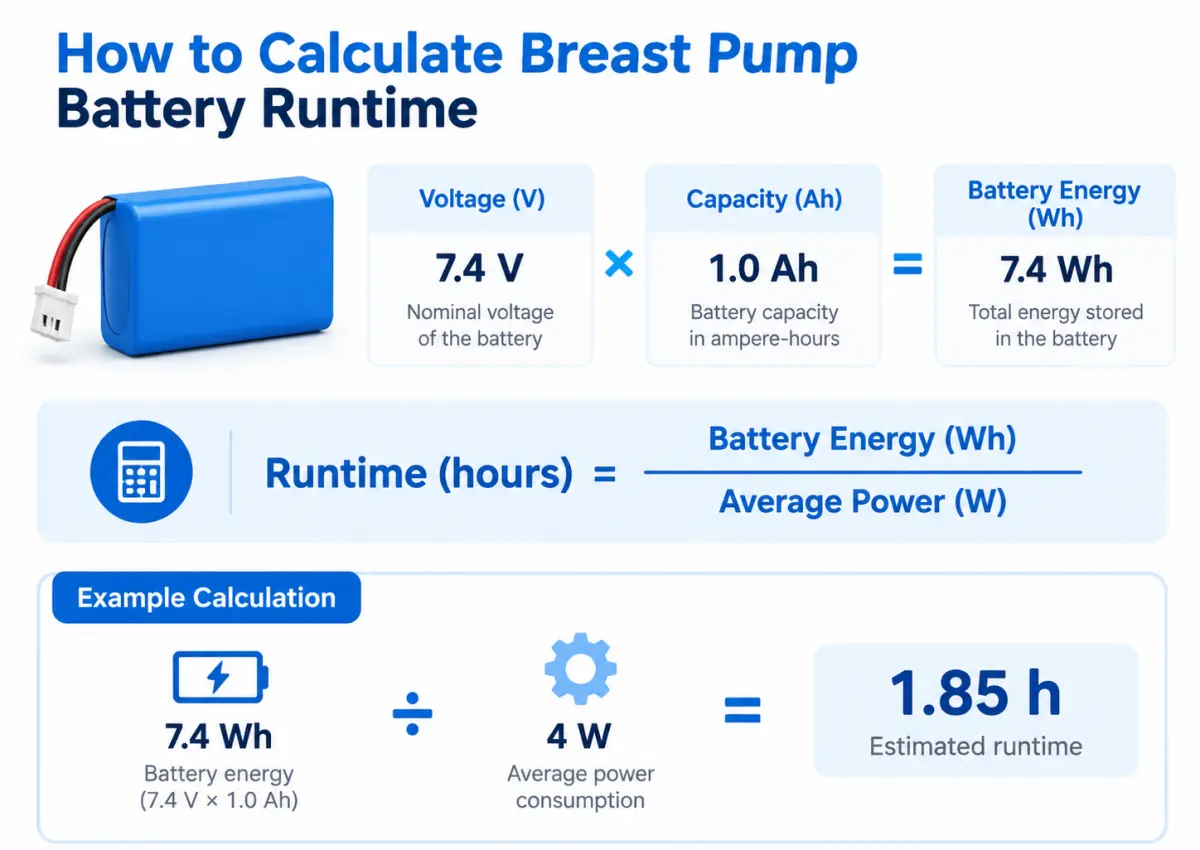
A basic estimate of operating time can be calculated from available battery energy and average device power consumption.
Ideal Runtime (hours) = Battery Energy (Wh) ÷ Average Power Consumption (W)
This formula provides a theoretical result.
For practical development, manufacturers should also account for the proportion of rated battery energy that can be used and the efficiency of the device's power electronics.
A more detailed estimate is:
Estimated Runtime (hours) = Battery Energy (Wh) × Usable Energy Factor × System Efficiency ÷ Average Load Power (W)
The usable energy factor reflects the portion of nominal battery energy available over the intended operating range.
System efficiency accounts for losses in power conversion and other relevant electrical components. These factors should be defined consistently so losses are not counted twice.
Example: Estimating Operating Time
Consider a hypothetical rechargeable breast pump with the following design assumptions:
| Parameter | Example Value |
|---|---|
| Battery nominal voltage | 3.7V |
| Battery capacity | 2000mAh |
| Nominal battery energy | 7.4Wh |
| Average load power | 4W |
| Usable energy factor | 90% |
| System efficiency | 85% |
Estimated runtime:
7.4Wh × 0.90 × 0.85 ÷ 4W = 1.42 hours
This equals approximately 85 minutes.
The calculation is an illustration only. It does not represent a guaranteed operating time for any existing breast pump model.
Actual runtime must be verified using the complete device under defined operating conditions.
4. How to Determine the Required Battery Capacity
Battery selection can also begin with the manufacturer's desired runtime.
Instead of estimating how long an existing battery will last, engineers can calculate the nominal energy needed to meet a target operating time.
The formula is:
Required Battery Energy (Wh) = Target Runtime (hours) × Average Load Power (W) ÷ (Usable Energy Factor × System Efficiency)
Example: Designing for Two Hours of Operation
Suppose an OEM manufacturer develops a breast pump with:
- Target runtime: 2 hours
- Average device load: 3W
- Usable energy factor: 90%
- System efficiency: 85%
- Battery nominal voltage: 3.7V
The nominal energy requirement is:
2 × 3 ÷ (0.90 × 0.85) = 7.84Wh
The corresponding nominal battery capacity is:
7.84Wh ÷ 3.7V = 2.12Ah
Therefore, the initial estimate is approximately 2120mAh.
The manufacturer would still need to choose an appropriate available cell, confirm its actual performance, and evaluate additional design margin.
A battery with a particular rated capacity should never be assumed to satisfy the runtime target without device-level validation.
5. Why Actual Breast Pump Runtime Can Differ From Calculations
Mathematical estimates are useful during early product development, but actual operating conditions can affect energy consumption and battery performance.
Motor Operating Conditions
Electric breast pumps use a motor-driven pumping mechanism.
The motor's current demand may change with the operating mode, pumping cycle, mechanical load, and device control strategy.
Different suction settings can therefore produce different electrical power requirements.
Voltage Conversion Losses
Some breast pumps use voltage regulators or other power-management circuits.
These components consume energy during operation, reducing the portion of stored battery energy available to the motor and other loads.
Battery Cutoff Settings
The battery protection circuit or device controller may stop operation before the battery's full nominal capacity has been discharged.
The cutoff threshold influences the usable energy available to the device.
Battery Temperature
Lithium battery performance depends partly on temperature.
Operation outside the intended temperature range may affect capacity, internal resistance, and voltage behavior.
Battery Aging
Battery capacity gradually changes with calendar aging and charge-discharge cycling.
If consistent operating time is required throughout the intended product service life, manufacturers should evaluate performance using aged-cell assumptions as well as new batteries.
6. Battery Size vs. Runtime: Finding the Right Balance
A higher-capacity battery can provide more stored energy, but increasing capacity may also increase battery size, weight, and cost.
These trade-offs are particularly important in wearable breast pumps.
Wearable devices generally place greater constraints on battery thickness, weight distribution, and available internal space than larger portable products.
As a result, the highest available capacity is not always the most suitable engineering choice.
Manufacturers should evaluate:
- Required operating time per charge
- Available battery compartment volume
- Maximum acceptable battery weight
- Average and peak device current
- Charging time targets
- Safety and protection requirements
- Expected battery service life
For more information about mechanical and electrical selection criteria, see our article on wearable breast pump battery selection.
7. Does Battery Chemistry Affect Runtime?
Lithium-ion batteries are available in different cell formats and constructions, including cylindrical cells and lithium polymer pouch cells.
The cell format can influence the battery's dimensions, capacity options, electrical characteristics, and mechanical integration.
However, cell shape alone does not determine runtime.
For example, the energy available from a battery also depends on its rated capacity, nominal voltage, discharge characteristics, and usable operating range.
An OEM manufacturer should compare actual cell specifications rather than assuming that one cell format always provides longer runtime.
Our guide on lithium polymer vs. 18650 batteries for breast pumps explains additional considerations for choosing between these cell formats.
8. How OEM Manufacturers Should Validate Battery Runtime
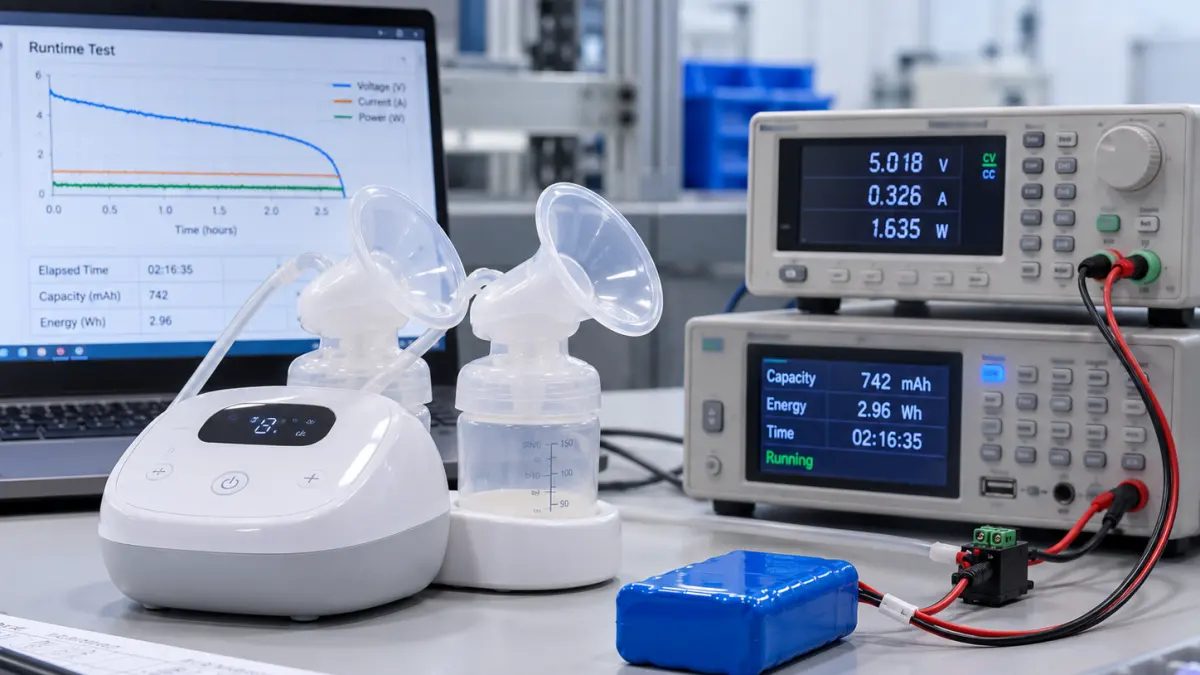
Runtime should be verified under repeatable device-level testing conditions.
An appropriate validation plan may include the following steps.
Step 1: Measure Power Consumption
Measure voltage, current, and power during normal operation.
Record performance across the relevant device settings and operating conditions.
Step 2: Establish a Repeatable Operating Cycle
Define a representative test cycle based on the intended use of the breast pump.
This helps ensure that prototype batteries are compared under consistent conditions.
Step 3: Test Multiple Battery Conditions
Evaluate runtime under the expected range of battery states and operating conditions.
Depending on project requirements, this can include variations in temperature, discharge current, and battery aging.
Step 4: Verify Charging and Protection Behavior
Confirm that the charging system, battery protection circuitry, and device cutoff controls operate as intended.
Step 5: Record Measured Performance
Document the tested battery configuration, device settings, test environment, and measured operating time.
These records help engineering and procurement teams compare prototypes and establish final battery specifications.
9. Custom Battery Development for Breast Pump Manufacturers
For an OEM project, battery capacity should be established alongside the product's mechanical and electrical design.
Manufacturers requesting a custom battery evaluation should provide:
- Product type and intended application
- Nominal voltage and acceptable voltage range
- Target operating time
- Average and peak power consumption
- Battery compartment dimensions
- Charging requirements
- Connector and wiring specifications
- Production quantity and applicable market requirements
Gloflux works with B2B customers developing application-specific lithium battery solutions.
Companies evaluating a rechargeable breast pump project can submit their specifications through the Gloflux custom lithium battery development page.
Frequently Asked Questions
1. How long should a breast pump battery last on one charge?
There is no universal runtime for all rechargeable breast pumps. Operating time depends on battery energy, device power consumption, operating settings, and system efficiency.
2. Does a higher mAh battery always provide longer runtime?
A higher mAh rating generally represents more charge capacity when comparing otherwise compatible batteries at the same nominal voltage. However, actual runtime also depends on usable energy and device consumption.
3. How do I calculate breast pump battery runtime?
Divide the battery's nominal energy in watt-hours by the average load power in watts for an ideal estimate. Include relevant usable-energy and efficiency factors to develop a more practical estimate.
4. Why does a breast pump battery lose runtime over time?
Rechargeable lithium batteries experience capacity changes as they age and undergo charge-discharge cycles. Temperature, charging conditions, and operating patterns can also influence long-term performance.
5. What information does a battery manufacturer need to estimate capacity?
The key information includes required voltage, average power consumption, target operating time, peak current, available battery dimensions, and charging requirements.
Conclusion
Understanding Breast Pump Battery Life requires more than comparing battery capacity ratings.
For OEM manufacturers, accurate battery sizing starts with electrical power measurements, energy calculations, and clearly defined operating requirements.
By evaluating battery voltage, usable capacity, device efficiency, and product dimensions together, engineering teams can identify suitable battery configurations for prototype testing.
Gloflux provides customized lithium battery development for B2B equipment manufacturers. Visit our custom battery solutions page to discuss your project requirements and production plans.
- PREV: 7.4V Battery Packs for Electric Breast Pumps: Design Guide
- NEXT: Null


