


 Home /
Why Does My BMS Keep Shutting Off?


Table of Contents
- Why Does a BMS Shut Off a Battery?
- Can Overcurrent Cause Repeated BMS Shutdowns?
- Can Low Cell Voltage Trigger the BMS?
- Can Temperature Make a BMS Shut Off?
- Can Cell Imbalance Cause Shutdowns?
- Could the Charger, Wiring, or Connector Be the Cause?
- How Do I Troubleshoot a BMS That Keeps Shutting Off?
- Does Repeated Shutdown Mean the BMS Is Faulty?
- Final Answer
- FAQ
If your battery works normally and then suddenly turns off, the Battery Management System may be entering protection mode. A BMS disconnects the battery when voltage, current, temperature, or another operating condition moves outside its permitted range.
When a BMS keeps shutting off, the shutdown is usually a symptom. The real task is to identify which protection function is being triggered and why.
Why Does a BMS Shut Off a Battery?
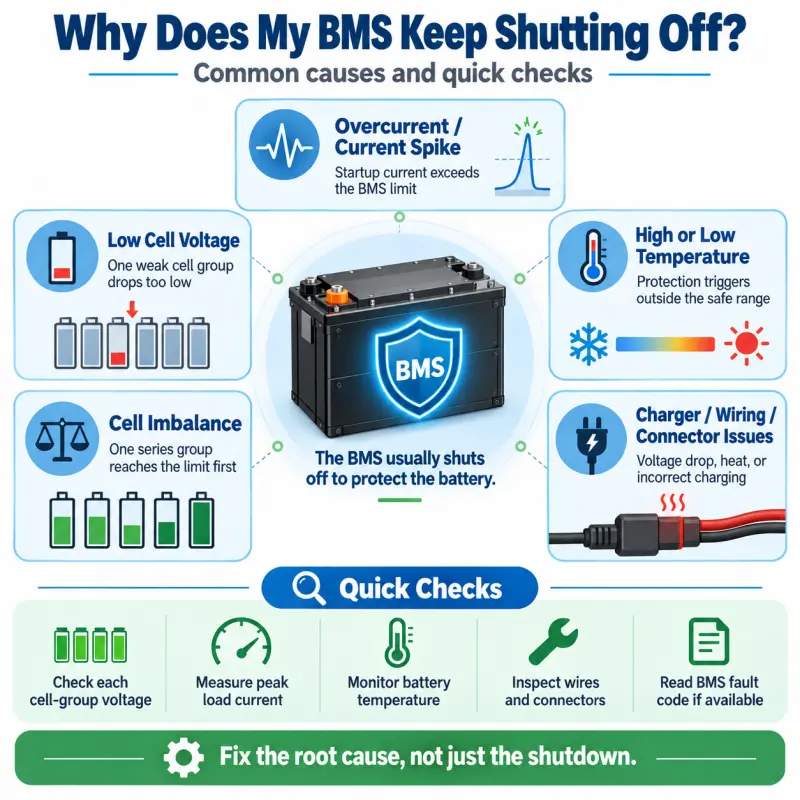
A BMS monitors the battery pack and can stop charging or discharging when it detects an abnormal condition. Common triggers include overcurrent, low or high cell voltage, short circuit, excessive temperature, low charging temperature, or excessive voltage difference between cell groups.
For a basic explanation of these functions, see our guide: What Does a BMS Do?
Can Overcurrent Cause Repeated BMS Shutdowns?
Yes. Overcurrent is one of the most common causes.
A device may use moderate current during normal operation but demand much more at startup. Motors, pumps, compressors, heaters, and wireless modules can create short current peaks.
For example, a device may normally draw 8A but briefly require 25A. If the BMS overcurrent threshold is too low, or its detection delay is too short, it may treat the startup peak as a fault and disconnect the battery.
BMS selection should consider continuous current, peak current, peak duration, and the protection threshold. See How to Calculate BMS Current for a Lithium Battery Pack for a more detailed method.
Can Low Cell Voltage Trigger the BMS?
Yes. A battery may show an acceptable total pack voltage while one cell group has already fallen below the low-voltage protection threshold.
This can happen because of cell imbalance, reduced capacity, increased internal resistance, or voltage sag under load. In a multi-series pack, one weak cell group may drop faster than the others and cause the BMS to disconnect the entire battery.
If the battery works again after resting or charging, low-voltage protection is worth checking.
Can Temperature Make a BMS Shut Off?
Yes. Many BMS designs use NTC sensors to monitor the cells, BMS board, or high-current areas.
If the battery becomes too hot during charging or discharging, the BMS may stop operation. High current, poor heat dissipation, high-resistance connections, or a hot environment can all contribute.
Some systems also prevent charging at low temperatures. A battery that charges normally indoors but stops in a cold environment may therefore be responding to temperature protection rather than a failed BMS.
Can Cell Imbalance Cause Shutdowns?
Yes. In a multi-series battery pack, one cell group can reach the upper or lower protection limit before the others.
During charging, a high-voltage group may trigger overcharge protection before the battery is fully charged. During discharge, a weak group may reach the low-voltage limit while other groups still have energy remaining.
Checking each series cell-group voltage is therefore more useful than checking only total battery voltage.
Could the Charger, Wiring, or Connector Be the Cause?
Yes. The charger must match the battery chemistry, series configuration, charge voltage, and allowed current. Incorrect charging conditions can trigger overvoltage, overcurrent, or temperature protection.
Loose terminals, undersized wires, weak welds, damaged conductors, or high-resistance connectors can also create voltage drop and heat. A high-current BMS cannot compensate for wiring or connectors that are not designed for the load.
How Do I Troubleshoot a BMS That Keeps Shutting Off?
First, record when the shutdown happens: at startup, during continuous operation, while charging, near low battery level, or at a particular temperature.
Then check pack voltage and individual cell-group voltage before, during, and after shutdown. Compare actual load current with the BMS continuous and peak-current limits. Also check battery temperature, charger output, cell balance, wiring, and connectors.
If the BMS supports communication or fault records, review the error code or event log. This can help identify whether the trigger was undervoltage, overcurrent, temperature, or another protection condition.
Does Repeated Shutdown Mean the BMS Is Faulty?
Not necessarily. In many cases, the BMS is protecting the battery from an electrical or thermal condition outside its limits.
However, incorrect protection settings, insufficient current capability, damaged MOSFETs, sensor problems, or a defective BMS can also cause unwanted shutdowns.
The BMS should be evaluated together with the cells, charger, load, wires, connector, temperature range, and application requirements. If you are choosing a new unit, see How to Choose a BMS for Lithium Battery Packs.
Final Answer
A BMS usually keeps shutting off because one of its protection limits is being triggered. Common causes include excessive current, startup current spikes, low cell voltage, voltage sag, cell imbalance, incorrect charging conditions, temperature limits, and resistance in wiring or connectors.
The fastest way to identify the cause is to determine exactly when the shutdown occurs and measure voltage, current, and temperature under the actual operating condition.
For custom battery projects, GLOFLUX can evaluate the cells, BMS or protection circuit, wiring, connector, NTC, charger, and real load together so the battery pack is matched to the application.
FAQ
Why does my BMS shut off when I connect a load?
The load may exceed the BMS current limit, or battery voltage may sag below the low-voltage threshold.
Why does my BMS reset after charging?
Charging can raise cell voltage above the recovery threshold and release low-voltage protection.
Can a weak cell cause BMS shutdown?
Yes. One weak cell group can reach a protection limit before the rest of the pack.
Why does my BMS shut off when a motor starts?
Motor startup current can be much higher than normal running current and may trigger overcurrent protection.
Can the wrong charger trip the BMS?
Yes. Incorrect charge voltage or excessive current can trigger protection.
Should I replace the BMS if it keeps shutting off?
Not immediately. First identify the protection condition. The problem may be the cells, load, charger, wiring, connector, temperature, or BMS settings.
Talk to the Manufacturer
Resources & Insights

High Capacity Lithium Battery for Wearables: High-Voltage LiPo Cell Design
2026-10-19
Cylindrical Battery Packs for Laptops: 2S vs 3S vs 4S Battery Design
2026-10-19

Stage Lighting Battery Pack: Prevent Voltage Drop & LED Flicker
2026-10-19

Best Rechargeable Batteries for Smart Devices: Performance, Safety, and Selection Guide
2026-10-19


