


 Home /
 7.4V 6.6Ah 18650 Li-ion Battery Pack for Oxygen Concentrators


Table of Contents
- Why Use a 7.4V 6.6Ah Battery Pack?
- 18650 Cells for Portable Medical Equipment
- What Does the BQ40Z50 Battery Management System Do?
- SMBus and I2C Communication
- Battery Protection for Oxygen Concentrator Applications
- Custom Battery Pack Design for OEM Projects
- Applications Beyond Oxygen Concentrators
- Choosing the Right Oxygen Concentrator Battery
- Frequently Asked Questions
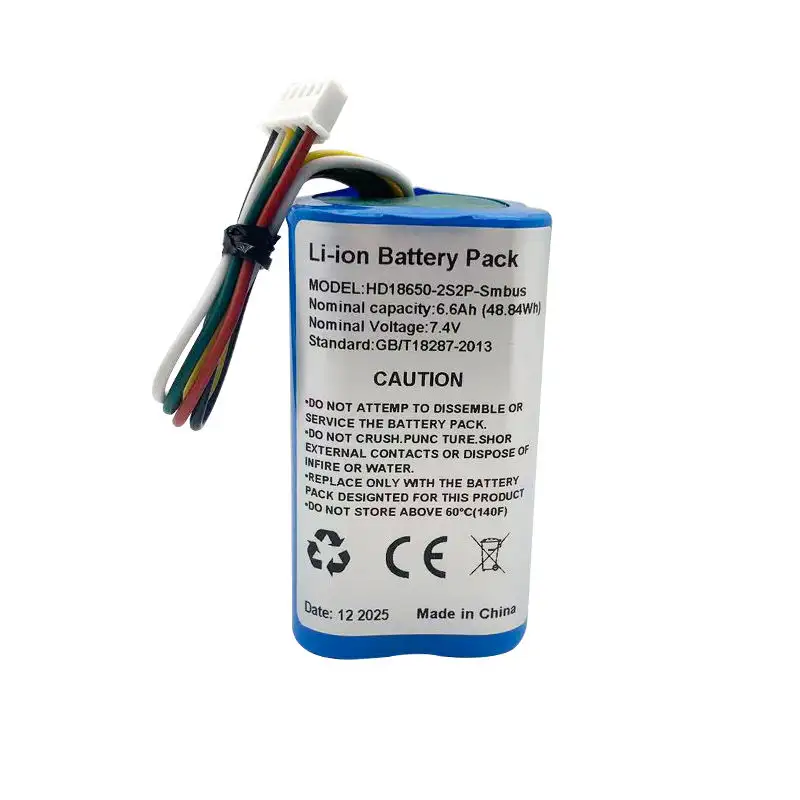
Portable oxygen concentrators and other medical devices need more than a battery that can simply provide power. For equipment that may be used continuously throughout the day, the battery system must also support stable output, battery status monitoring, safety protection, and reliable communication with the host device. A 7.4V 6.6Ah 18650 Li-ion Battery Pack equipped with BQ40Z50 battery management and SMBus/I2C communication offers a practical solution for oxygen concentrators and other portable healthcare equipment.
By combining rechargeable 18650 lithium-ion cells with an intelligent battery management system, this type of battery pack can provide both usable energy and important operating data to the medical device.
Why Use a 7.4V 6.6Ah Battery Pack?
A 7.4V lithium-ion battery pack is typically based on a two-series-cell configuration. With a capacity of 6.6Ah, the battery can provide a useful balance between energy storage, physical size, and weight for portable equipment.
For an oxygen concentrator, battery capacity directly affects how long the equipment can operate away from an AC power source. However, capacity alone does not determine whether a battery is suitable. Current demand, internal resistance, temperature, discharge rate, device efficiency, and battery management settings all influence actual operating time.
This is why an OEM battery solution should be selected according to the complete electrical requirements of the oxygen concentrator rather than voltage and capacity alone.
18650 Cells for Portable Medical Equipment
The 18650 Li-ion battery remains widely used in portable electronics and equipment because it combines compact dimensions with practical energy density and mature manufacturing technology.
For oxygen concentrator battery packs, multiple 18650 cells can be arranged to meet the required voltage and capacity while allowing the overall pack shape to be adapted to the device enclosure.
Cell consistency is particularly important in multi-cell battery packs. Differences in capacity, voltage, and internal resistance can affect pack performance over repeated charge and discharge cycles. Battery manufacturers therefore need to consider cell matching, pack assembly, insulation, welding quality, temperature sensing, and battery management as part of the complete design.
What Does the BQ40Z50 Battery Management System Do?
One of the key features of this battery pack is the use of the BQ40Z50 battery management solution.
Instead of functioning only as a basic protection circuit, an intelligent battery management system can collect and process battery operating information. Depending on the final battery configuration, the system can monitor parameters such as:
- Battery voltage
- Charge and discharge current
- Cell temperature
- Remaining battery capacity
- State of charge
- Battery operating status
This information can help the oxygen concentrator understand the condition of its battery and provide more useful battery information to the user.
For OEM medical device projects, communication between the battery and the equipment can also support more coordinated power management.
SMBus and I2C Communication
A conventional lithium battery pack may only provide positive and negative power terminals. An intelligent battery pack can include additional communication lines.
This BQ40Z50 battery pack supports SMBus and I2C-based communication configurations, allowing compatible equipment to exchange battery information with the battery management system.
For example, the host device may be able to read remaining capacity, voltage, current, temperature, or other programmed battery information. This can be particularly useful in portable oxygen concentrators where the user needs a clearer understanding of available battery power.
Communication specifications must be matched carefully during product development. Connector pin definition, communication protocol, firmware settings, and host-device requirements should therefore be confirmed before production.
Battery Protection for Oxygen Concentrator Applications
Battery safety is especially important when a rechargeable lithium battery is integrated into portable healthcare equipment.
Depending on the final design, the 7.4V 6.6Ah battery pack can incorporate protection functions for conditions such as overcharge, over-discharge, overcurrent, short circuit, and abnormal temperature.
These functions help the battery management system respond when operating conditions move outside the configured limits.
However, battery protection parameters should not simply be copied from another product. Different oxygen concentrators can have different startup currents, discharge profiles, charging systems, operating temperatures, and enclosure designs. Protection thresholds should therefore be configured according to the actual equipment requirements.
Custom Battery Pack Design for OEM Projects
Medical equipment manufacturers often need a battery designed around their existing device rather than a standard off-the-shelf battery.
A custom 7.4V 6.6Ah 18650 battery pack can be developed with different:
- Battery pack dimensions
- Housing structures
- Wire lengths
- Connectors
- Terminal layouts
- Temperature sensors
- SMBus or I2C communication settings
- BMS parameters
- Label and packaging requirements
For replacement battery projects, engineers may also need to confirm the original battery voltage, maximum dimensions, connector type, pin definition, communication requirements, charging voltage, and equipment power demand.
Providing these details early can reduce unnecessary redesign during sample development.
Applications Beyond Oxygen Concentrators
Although this battery configuration is particularly suitable for portable oxygen concentrators, the same battery architecture can potentially be adapted for other equipment requiring rechargeable power and intelligent battery communication.
Possible applications include portable respiratory equipment, healthcare monitoring devices, diagnostic equipment, home healthcare products, and other portable medical electronics.
The exact suitability depends on the equipment's voltage, current, capacity, communication, mechanical, and safety requirements.
Choosing the Right Oxygen Concentrator Battery
When selecting an oxygen concentrator battery, buyers should look beyond nominal voltage and capacity.
The correct battery should match the equipment electrically, mechanically, and digitally. This includes checking the required operating voltage, discharge current, battery dimensions, connector design, communication protocol, charging system, temperature range, and protection settings.
For equipment using intelligent battery communication, confirming SMBus or I2C requirements is particularly important. A battery with the correct voltage and connector may still not work correctly if the communication protocol or firmware configuration does not match the host device.
A customized BQ40Z50-based battery solution can therefore be a useful option for manufacturers developing or replacing intelligent battery systems in portable oxygen concentrators.
Frequently Asked Questions
1. What equipment can use a 7.4V 6.6Ah 18650 Li-ion battery pack?
It can be designed for portable oxygen concentrators, respiratory equipment, medical monitoring devices, and other portable electronics requiring a compatible 7.4V lithium battery system.
2. What is the purpose of the BQ40Z50 in the battery pack?
The BQ40Z50 supports intelligent battery monitoring and management, including information such as voltage, current, temperature, remaining capacity, and battery status.
3. Does this battery support SMBus communication?
Yes. The battery system can be configured with SMBus communication for compatible host devices. Communication protocol and pin definitions should be confirmed during OEM development.
4. Can the connector and battery size be customized?
Yes. Battery dimensions, connectors, wiring, enclosure structure, communication settings, and BMS parameters can be customized according to the equipment design.
5. Can this battery replace any 7.4V oxygen concentrator battery?
Not necessarily. Voltage alone is not enough to confirm compatibility. Capacity, dimensions, connector pinout, discharge current, charging requirements, and SMBus or I2C communication must also match the original equipment.
Talk to the Manufacturer
Resources & Insights
High Capacity Lithium Battery for Wearables: High-Voltage LiPo Cell Design
2026-10-19
Cylindrical Battery Packs for Laptops: 2S vs 3S vs 4S Battery Design
2026-10-19
Stage Lighting Battery Pack: Prevent Voltage Drop & LED Flicker
2026-10-19
Best Rechargeable Batteries for Smart Devices: Performance, Safety, and Selection Guide
2026-10-19


