


 Home /
 11.1V 1000mAh–1200mAh 20C–25C 502096/5020120 Li-Ion Battery Pack for Electric Toy Blasters and Water Guns


Table of Contents
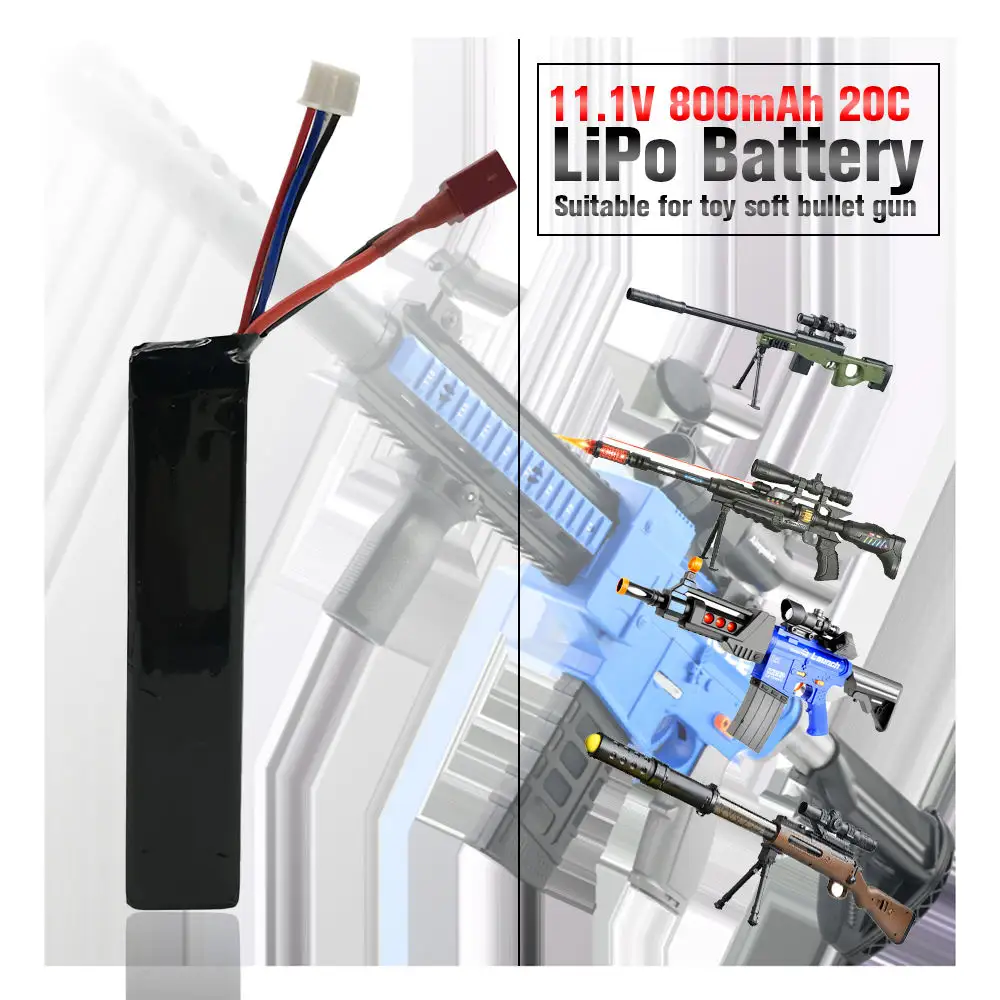
An 11.1V Li-Ion Battery Pack for Toy Blasters provides the power required for fast motor response, stable firing performance, and reliable operation in rechargeable electric toys. It is commonly used in electric soft-dart blasters, gel ball toys, motor-driven launchers, electric water guns, and other compact recreational products.
Compared with ordinary low-discharge batteries, an 11.1V high-rate lithium-ion battery can supply the current required by motors and water pumps during startup and repeated operation. However, voltage, capacity, discharge rate, battery dimensions, connector type, and protection design must all match the equipment.
For toy manufacturers and product developers, selecting the correct battery is not only about finding a suitable voltage. The battery must fit the available compartment, support peak current demand, deliver the expected runtime, and comply with the product’s charging and safety requirements.
What Is an 11.1V Li-Ion Battery Pack?
An 11.1V lithium-ion battery pack normally uses three lithium-ion cells connected in series, also known as a 3S configuration. Each cell has a nominal voltage of approximately 3.7V, producing a combined nominal voltage of 11.1V.
The fully charged voltage of a standard 3S lithium-ion battery pack is typically higher than its nominal voltage. Therefore, the toy’s motor, controller, wiring, switches, and charging system must be designed for the complete battery voltage range.
An 11.1V battery should not be installed in a toy designed only for a lower-voltage power source. Excessive voltage may increase motor speed, electrical stress, heat generation, and component wear. Compatibility should always be confirmed during product development.
Why High-Discharge Performance Matters
Electric toy blasters and water guns often contain motors or pumps that require a strong current during startup. The battery must deliver this current without excessive voltage drop.
A 20C or 25C battery is designed for higher discharge performance than a standard low-rate battery of the same capacity. A suitable high-discharge battery can support:
- Rapid motor startup
- Responsive trigger operation
- Consistent firing speed
- Stable water-pump pressure
- Reliable performance during repeated use
- Reduced voltage drop under load
The C-rate alone should not be used as the only selection factor. Buyers should confirm both the continuous discharge current and the short-duration peak current with the battery manufacturer.
The cells, protection circuit, nickel connections, wires, and connector must all support the required current. A high-rate cell combined with an undersized wire or connector may still limit the battery pack’s performance.
Choosing Between 1000mAh and 1200mAh
Capacity affects runtime, battery size, weight, and cost. The 1000mAh and 1200mAh options are suitable for compact electric toys where space is limited.
A 1000mAh battery may be selected when the product requires a smaller or lighter power source. A 1200mAh battery can provide additional operating time when the battery compartment allows for a larger cell format.
Actual runtime depends on several factors:
- Motor or pump power
- Average working current
- Peak current frequency
- Firing or pumping duration
- Lighting and sound functions
- Control board consumption
- Battery age and operating temperature
A larger capacity does not automatically mean a better battery solution. Product developers should balance runtime requirements with available installation space and the desired weight of the finished toy.
Understanding 502096 and 5020120 Cell Sizes
The 502096 and 5020120 model numbers usually describe lithium battery cell dimensions. These slim cell formats can be useful for toy products with narrow battery compartments or flat internal structures.
Compared with cylindrical cells, a flat lithium battery can provide more flexible installation in handles, stocks, body shells, or custom enclosures. The two models may differ in length, capacity, weight, and discharge performance.
Before selecting a cell, the buyer should provide accurate battery compartment dimensions. Additional space may be required for wires, connectors, protection components, insulation materials, and battery movement during installation.
The battery should not be compressed, bent, punctured, or installed against sharp internal parts. A secure mechanical structure can help protect the battery from vibration and impact during normal use.
Battery Protection and Charging Design
Lithium-ion battery packs require a compatible charging system and appropriate protection. Depending on the battery design and application, the pack may include protection against:
- Overcharging
- Over-discharging
- Excessive current
- Short circuits
- Abnormal temperature conditions
For a high-discharge toy battery, the protection circuit must support the motor’s normal working current and startup current. An unsuitable protection board may shut down the battery when the motor starts, even when the cells have enough discharge capability.
The battery must be charged with a charger designed for the correct cell configuration and charging voltage. Using an incompatible charger may damage the battery or create a safety risk.
Manufacturers should provide clear instructions covering charging, use, storage, inspection, and replacement. Damaged, swollen, leaking, or overheated batteries should not be used.
Custom Battery Options for OEM Toy Projects
A standard battery may not meet every product requirement. OEM and ODM battery customization allows the power solution to be developed around the actual toy design.
Common customization options include:
- 1000mAh or 1200mAh capacity
- 20C or 25C discharge performance
- Battery dimensions and cell arrangement
- Connector model and polarity
- Wire length and wire gauge
- Protection circuit specifications
- Outer wrapping or protective casing
- Product labels and warning information
- Charger and charging cable options
- Individual or bulk packaging
Before requesting a custom battery, buyers should provide the equipment voltage, working current, peak current, battery compartment size, connector details, expected runtime, charging method, operating temperature, and target market.
Providing complete technical information early can reduce repeated sampling and help the battery manufacturer recommend a more appropriate solution.
Typical Applications
An 11.1V high-discharge lithium-ion battery pack can be used in compatible products such as:
- Electric soft-dart toy blasters
- Gel ball blasters
- Electric water guns
- Motor-driven toy launchers
- Rechargeable shooting toys
- Remote-controlled entertainment devices
- Toy upgrade battery systems
- Customized motor-powered recreational products
Battery suitability must be evaluated separately for each application. Products with the same voltage may still have different current, size, connector, and charging requirements.
Conclusion
The right 11.1V Li-Ion Battery Pack for Toy Blasters should provide stable voltage, suitable high-current output, practical runtime, compact dimensions, and reliable protection.
A 1000mAh or 1200mAh battery using a 502096 or 5020120 cell format can be a practical solution for electric toy blasters and water guns with limited installation space. The 20C–25C discharge capability supports responsive motors and pumps when the complete battery system is properly designed.
For OEM projects, customizing the dimensions, connector, wire, protection circuit, discharge current, and packaging can improve compatibility and support reliable mass production.
Frequently Asked Questions
1. Can an 11.1V battery be used in any electric toy blaster?
No. The motor, controller, wiring, and charging system must support an 11.1V 3S lithium-ion battery. Always confirm voltage compatibility before installation.
2. What is the difference between a 20C and 25C battery?
A 25C battery is designed to provide a higher discharge rate relative to its capacity. However, actual continuous and peak current ratings should be confirmed with the supplier.
3. Should I choose a 1000mAh or 1200mAh battery?
Choose 1000mAh when compact size and lower weight are priorities. Select 1200mAh when longer runtime is required and sufficient installation space is available.
4. Can the connector and battery dimensions be customized?
Yes. Battery dimensions, connector type, polarity, wire length, discharge rate, capacity, protection circuit, casing, and labels can be customized for OEM projects.
5. What information is required for a custom toy battery pack?
Provide the operating voltage, normal and peak current, battery compartment dimensions, connector details, expected runtime, charging method, working temperature, and target market.
Talk to the Manufacturer
Resources & Insights
High Capacity Lithium Battery for Wearables: High-Voltage LiPo Cell Design
2026-10-19
Cylindrical Battery Packs for Laptops: 2S vs 3S vs 4S Battery Design
2026-10-19
Stage Lighting Battery Pack: Prevent Voltage Drop & LED Flicker
2026-10-19
Best Rechargeable Batteries for Smart Devices: Performance, Safety, and Selection Guide
2026-10-19


