


 Home /
How Many Cells Do I Need for a Lithium Battery Pack?


Table of Contents
- What Does Series and Parallel Mean in a Battery Pack?
- How Do I Calculate the Number of Cells in Series?
- How Do I Calculate the Number of Parallel Cells?
- How Do I Calculate the Total Cell Count?
- Can I Calculate Cell Count Using Watt-Hours?
- Does the Cell Count Also Depend on Discharge Current?
- Does Cell Chemistry Change the Calculation?
- What Else Should I Check Before Finalizing the Design?
- FAQ
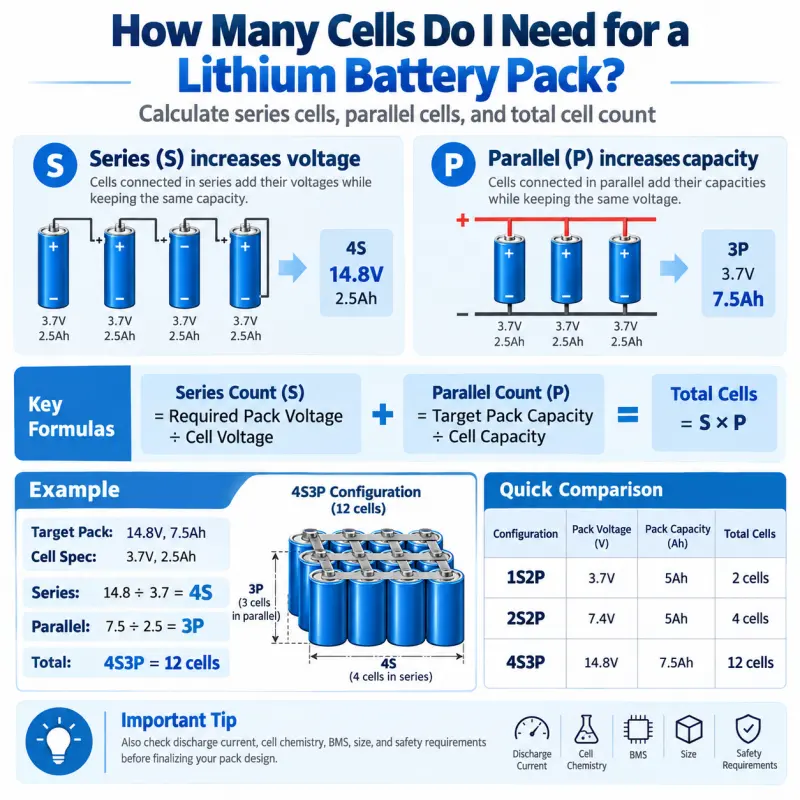
The number of cells in a lithium battery pack depends on three requirements: operating voltage, required capacity, and discharge current. Cells connected in series increase voltage, while cells connected in parallel increase capacity and available current. The selected cell specifications determine the final lithium battery pack cell count.
What Does Series and Parallel Mean in a Battery Pack?
A battery configuration is commonly written as 2S3P or 4S2P. S represents the number of cells connected in series, and P represents the number of cells connected in parallel within each series group.
| Connection | Main Purpose | Example Using 3.7V, 2.5Ah Cells |
|---|---|---|
| Series (S) | Increase pack voltage | 4S1P = 14.8V, 2.5Ah |
| Parallel (P) | Increase pack capacity | 1S3P = 3.7V, 7.5Ah |
| Combined | Meet both requirements | 4S3P = 14.8V, 7.5Ah |
These examples use nominal voltage; charging and protection specifications must account for the full voltage range.
How Do I Calculate the Number of Cells in Series?
Divide the required nominal pack voltage by the nominal voltage of one cell:
Series Count (S) = Required Pack Voltage ÷ Cell Voltage
For a device designed for a nominal 14.8V lithium-ion battery, using 3.7V cells:
14.8 ÷ 3.7 = 4
You need four cells in series, written as 4S.
Confirm that the device accepts the pack's full operating voltage range. Four conventional 4.2V-max lithium-ion cells, for example, reach 16.8V when fully charged.
Cell specifications and charging limits always take priority over rounded calculations.
How Do I Calculate the Number of Parallel Cells?
Next, divide your target pack capacity by the rated capacity of one cell:
Parallel Count (P) = Target Pack Capacity ÷ Cell Capacity
Suppose your design requires 7.5Ah and you select 2.5Ah cells:
7.5 ÷ 2.5 = 3
You need three parallel cells per series group, or 3P.
If the result is not a whole number, round up and verify that the resulting pack fits your size and weight constraints.
If you have not yet established your required capacity, start with How to Calculate Battery Capacity for a Device.
How Do I Calculate the Total Cell Count?
Multiply the series count by the parallel count:
Total Cells = S × P
Continuing our example, a 14.8V, 7.5Ah pack built from 3.7V, 2.5Ah cells requires 4S3P, or 12 cells total.
| Target Pack | Cell Specification | Configuration | Total Cells |
|---|---|---|---|
| 3.7V, 5Ah | 3.7V, 2.5Ah | 1S2P | 2 |
| 7.4V, 5Ah | 3.7V, 2.5Ah | 2S2P | 4 |
| 14.8V, 7.5Ah | 3.7V, 2.5Ah | 4S3P | 12 |
These are illustrative configurations, not recommended designs for every application.
Can I Calculate Cell Count Using Watt-Hours?
Yes. Watt-hours (Wh) express energy and are particularly helpful when your product's power consumption and operating time are known.
Required Energy (Wh) = Average Load Power (W) × Runtime (Hours)
For example, a 15W device operating for six hours theoretically needs 90Wh.
After accounting for conversion losses, usable capacity, temperature, and aging, its specified pack may need additional energy.
Once you select a pack voltage, divide required Wh by nominal voltage to estimate Ah; then calculate parallel count.
You can also estimate operating time using our guide: How Do I Calculate Battery Runtime from Ah and Wh?
Does the Cell Count Also Depend on Discharge Current?
Absolutely. A pack can meet voltage and capacity targets but still fail to supply the device's peak load.
Check the continuous and pulse-discharge ratings in the actual cell datasheet.
For example, if a load draws 20A and each selected cell is rated for 5A continuous discharge under the intended conditions, four parallel cells provide a theoretical 20A combined rating.
That is only an initial check: temperature, voltage sag, aging, interconnects, and engineering margins can require a different configuration.
The BMS must also match the series count and current requirements.
See our guide to Choosing a BMS for Lithium Battery Packs.
Does Cell Chemistry Change the Calculation?
Yes. Nominal cell voltage varies by chemistry.
Common Li-ion and LiPo cells are often rated around 3.6–3.7V, while LiFePO4 cells are commonly rated at 3.2V.
Four 3.2V LiFePO4 cells in series produce a nominal 12.8V pack, not 14.8V.
Never mix cell chemistries or assume they share charging limits.
Chemistry also influences available capacity, discharge capability, temperature performance, and pack dimensions.
What Else Should I Check Before Finalizing the Design?
The calculated cell count is a starting point, not a complete pack design.
Verify that the chosen cells physically fit alongside the BMS, insulation, wiring, connectors, and enclosure.
Use appropriately matched cells and account for production tolerances, expected service life, charging requirements, and relevant safety testing.
For regulated or high-current applications, have a qualified battery engineering team validate the electrical and mechanical design rather than relying on arithmetic alone.
GLOFLUX supports custom pack design, including cell selection, BMS integration, connectors, and mechanical layout.
If you have product drawings or a space-constrained enclosure, see our article on Developing a Battery Pack from Product Drawings.
FAQ
Can I Use Different-Capacity Cells in One Pack?
Avoid mixing cells with different capacities, ages, chemistries, or performance characteristics. Cells should be matched according to an approved pack design.
Does Connecting Cells in Series Increase Ah?
No. Series connections increase voltage; a series string retains approximately the Ah rating of one cell.
Does Connecting Cells in Parallel Increase Voltage?
No. Parallel connections increase total Ah and potential current capability while nominal voltage stays approximately the same.
How Many 18650 Cells Do I Need for a 12V Battery?
It depends on chemistry, actual cell specifications, your device's permitted voltage range, capacity target, and current draw. There is no single correct count for every 12V application.
Is a 4S2P Pack Eight Cells?
Yes. Four series groups with two cells in parallel per group require eight cells in total.
Can I Increase Capacity Without Changing Voltage?
Usually, adding matched parallel cells or groups increases nominal capacity without changing the number of series groups. The design and BMS still require validation.
Talk to the Manufacturer
Resources & Insights

High Capacity Lithium Battery for Wearables: High-Voltage LiPo Cell Design
2026-10-19
Cylindrical Battery Packs for Laptops: 2S vs 3S vs 4S Battery Design
2026-10-19

Stage Lighting Battery Pack: Prevent Voltage Drop & LED Flicker
2026-10-19

Best Rechargeable Batteries for Smart Devices: Performance, Safety, and Selection Guide
2026-10-19


