


 Home /
 Custom 24V 25.9V 36V 5Ah Li-ion Battery Pack for Exoskeleton Robots


Table of Contents
- Why Exoskeleton Robots Need Custom Battery Packs
- 24V, 25.9V, and 36V Voltage Options
- 5Ah Capacity for Reliable Runtime
- 18650 and 21700 Li-ion Cell Options
- Built-In Protection for Safer Operation
- Durable Structure for Wearable and Mobile Use
- Application Fields
- OEM and ODM Customization Support
- Conclusion
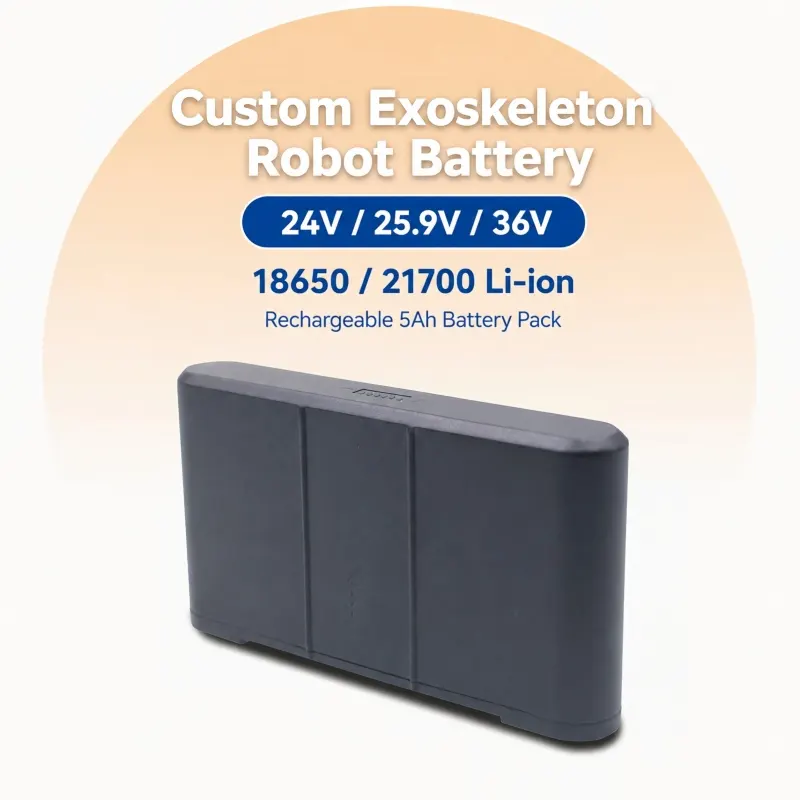
As wearable robotics and intelligent assistive systems continue to develop, the demand for reliable battery power has become more important than ever. Exoskeleton robots require compact, stable, and efficient energy sources to support motion control, sensors, communication modules, and actuator systems. A custom 24V, 25.9V, or 36V 5Ah Li-ion battery pack offers a practical power solution for different exoskeleton robot designs, from rehabilitation equipment to industrial assistive devices.
Unlike standard consumer batteries, exoskeleton robot batteries must meet strict requirements for voltage stability, safety, runtime, size, weight, and connection structure. A well-designed lithium-ion battery pack can help improve robot mobility, reduce downtime, and support smoother performance during daily operation.
Why Exoskeleton Robots Need Custom Battery Packs
Exoskeleton robots often have different power requirements depending on their structure, working load, motor system, and application environment. Some systems need a lightweight 24V battery pack for compact wearable equipment, while others may require 25.9V or 36V configurations for stronger power output and longer operating time.
A custom battery pack allows engineers and manufacturers to match the battery design with the robot’s actual power system. Voltage, capacity, discharge current, connector type, cable length, housing style, mounting position, and communication function can all be adjusted according to the project. This flexibility is especially valuable for robotic products that have limited internal space or need a specific installation method.
For exoskeleton robots, battery weight also affects user comfort. A bulky or poorly balanced battery can reduce mobility and increase user fatigue. Custom battery design helps create a better balance between energy storage and wearable comfort.
24V, 25.9V, and 36V Voltage Options
Different exoskeleton systems use different voltage platforms. A 24V Li-ion battery pack is commonly used in compact assistive devices, lightweight robotic systems, and low-to-medium power wearable equipment. It provides stable power while keeping the battery size manageable.
A 25.9V Li-ion battery pack is often based on a 7-series lithium-ion configuration. It can provide a higher working voltage than 24V systems and may suit robotic applications that need improved motor performance or more efficient power delivery.
A 36V battery pack is suitable for exoskeleton robots that require stronger output for lifting assistance, walking support, or industrial workload reduction. It can help drive higher-power motors and support more demanding operating conditions.
Choosing the right voltage depends on the robot’s controller, motor specifications, peak current demand, runtime target, and safety design. For OEM and ODM projects, battery engineers can help evaluate these factors before designing the final pack.
5Ah Capacity for Reliable Runtime
Capacity is one of the key factors that determines how long an exoskeleton robot can operate before recharging. A 5Ah lithium-ion battery pack provides a balanced solution for many wearable robotic systems. It offers practical runtime without making the battery too large or too heavy.
For rehabilitation robots, stable runtime helps therapists complete training sessions without frequent battery changes. For industrial exoskeletons, longer operation supports workers during lifting, carrying, assembly, and repetitive movement tasks. For research and development projects, a dependable 5Ah pack allows engineers to test robot functions more consistently.
Runtime can vary depending on motor load, user weight, working mode, terrain, and system efficiency. Therefore, custom battery design should consider both rated capacity and actual working current. This helps ensure that the battery pack meets real application needs instead of only meeting basic specification targets.
18650 and 21700 Li-ion Cell Options
Custom exoskeleton robot battery packs can be built with 18650 or 21700 lithium-ion cells. Both cell types are widely used in professional battery pack manufacturing, but they offer different design advantages.
18650 cells are mature, stable, and widely available. They are suitable for compact battery packs, flexible layout designs, and applications that require proven cell performance. Many robotic battery packs use 18650 cells because they offer a good balance between energy density, cost, and reliability.
21700 cells usually provide higher capacity and stronger discharge performance than many 18650 cells. They are suitable for battery packs that need higher energy density, longer runtime, or improved current output. For exoskeleton robots with stronger motor loads, 21700 cells can be a valuable option.
The final cell selection should depend on the required voltage, capacity, current, pack size, weight target, cycle life, and cost requirements.
Built-In Protection for Safer Operation
Safety is essential for wearable robotics because the battery operates close to the human body. A custom Li-ion battery pack for exoskeleton robots should include a reliable protection circuit or battery management system. This protection helps monitor and control charging and discharging behavior.
Common protection functions include overcharge protection, over-discharge protection, overcurrent protection, short-circuit protection, and temperature protection. These features help reduce the risk of battery damage, overheating, unstable output, and electrical failure.
For more advanced robotic systems, the battery pack can also support additional functions such as cell balancing, NTC temperature monitoring, charge status indication, and communication protocols. These features can help the robot controller monitor battery performance more accurately and improve system management.
Durable Structure for Wearable and Mobile Use
Exoskeleton robots often operate in active environments. The battery pack may experience movement, vibration, impact, and repeated installation or removal. Therefore, the mechanical structure of the battery is just as important as the electrical design.
A durable housing can protect the internal cells, wiring, and protection circuit from external stress. The battery enclosure can be designed with plastic casing, heat-shrink wrapping, metal support parts, mounting brackets, or customized shell structures depending on the device design.
Connector selection also matters. A secure connector helps prevent power interruption during movement. Cable length, wire gauge, plug type, and locking structure should match the robot’s internal layout and current demand.
Application Fields
A custom 24V, 25.9V, or 36V 5Ah Li-ion battery pack can be used in many types of exoskeleton robot systems. In medical rehabilitation, it can power lower-limb training robots, mobility assistance devices, and therapy support systems. These applications require safe, stable, and rechargeable power for repeated daily use.
In industrial environments, exoskeleton robots help workers reduce physical strain during lifting, carrying, assembly, and repetitive tasks. A reliable battery pack supports continuous operation and helps improve workplace efficiency.
In research and development, universities, laboratories, and robotics companies often need customized battery solutions for prototype testing. A flexible battery design allows engineers to adjust voltage, size, capacity, and connector layout as the robot design changes.
This battery pack can also support wearable assistive equipment, mobile robotic platforms, smart rehabilitation devices, and other portable automation systems.
OEM and ODM Customization Support
For robotic manufacturers, standard battery products may not fully match the final equipment design. OEM and ODM customization can solve this problem by adapting the battery pack to the product’s electrical and mechanical requirements.
Customization options may include voltage, capacity, cell type, discharge current, charging method, protection board, connector, cable, shell design, label, certification support, and packaging. With professional battery engineering support, manufacturers can create a battery pack that fits the robot safely and efficiently.
Conclusion
A custom 24V, 25.9V, or 36V 5Ah Li-ion battery pack is an important power solution for exoskeleton robots and wearable robotic systems. With flexible voltage options, 18650 or 21700 cell configurations, built-in safety protection, and customizable structure, it can meet the needs of rehabilitation equipment, industrial assistive robots, mobile robotic devices, and R&D projects.
For manufacturers developing exoskeleton robot products, choosing the right battery pack helps improve runtime, safety, comfort, and overall system performance. A well-designed custom lithium-ion battery does more than supply power; it supports the reliability and usability of the entire robotic system.
Talk to the Manufacturer
Resources & Insights
High Capacity Lithium Battery for Wearables: High-Voltage LiPo Cell Design
2026-10-19
Cylindrical Battery Packs for Laptops: 2S vs 3S vs 4S Battery Design
2026-10-19
Stage Lighting Battery Pack: Prevent Voltage Drop & LED Flicker
2026-10-19
Best Rechargeable Batteries for Smart Devices: Performance, Safety, and Selection Guide
2026-10-19


