


 Home /
 Custom 18650 21700 Rechargeable Lithium Battery Pack for Robots


Table of Contents
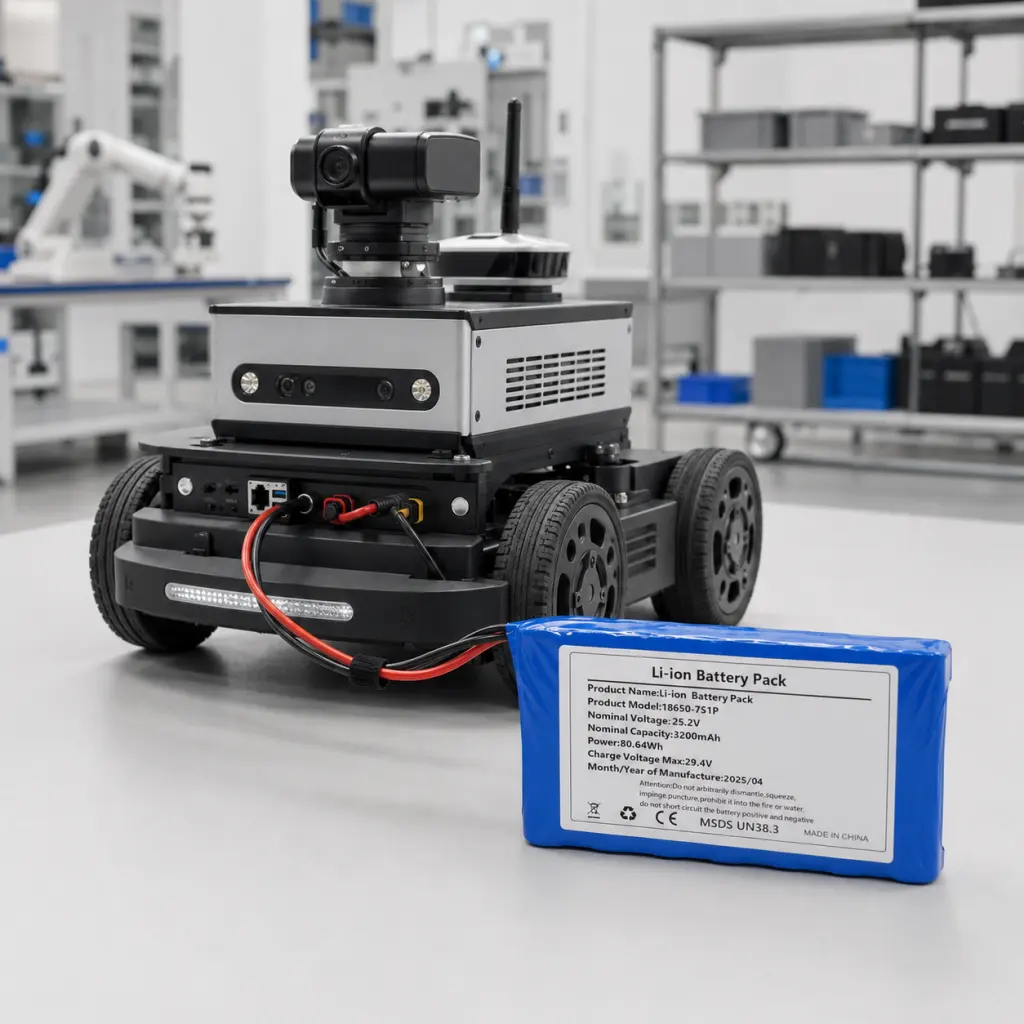
Robots need stable, safe, and long-lasting power to perform reliably in different working environments. Whether the device is an RC robot, service robot, inspection robot, AGV, educational robot, or industrial mobile platform, the battery pack directly affects runtime, movement stability, charging efficiency, and overall user experience. A Custom 18650 21700 Rechargeable Lithium Battery Pack for Robots offers flexible power options for different robotic systems, helping engineers match voltage, capacity, size, connector, discharge rate, and protection design according to the actual application.
Why Robots Need Custom Lithium Battery Packs
Robotic equipment often has limited internal space, strict weight requirements, and different power consumption levels. A small RC robot may need a compact 7.4V or 11.1V pack, while a mobile inspection robot or industrial robot platform may require higher capacity, stronger discharge performance, or a more advanced BMS. Standard battery packs may not always fit the robot structure or support the required working time.
Custom lithium battery packs allow manufacturers and developers to design the power system around the robot’s real operating needs. The battery can be adjusted by voltage, capacity, cell arrangement, connector type, wire length, protection circuit, shell or wrapping method, and charging interface. This helps improve compatibility and reduces the risk of unstable performance during operation.
18650 and 21700 Cell Options
18650 and 21700 lithium cells are widely used in robot battery packs because they provide a good balance between energy density, discharge capability, cycle life, and structural flexibility. 18650 cells are compact and suitable for smaller robot designs, portable devices, RC platforms, and equipment with limited battery space. They are commonly used in 3.7V, 7.4V, 10.8V, 11.1V, 12V, and 14.8V battery pack configurations.
21700 cells generally offer higher capacity and better energy output than many 18650 cells. They are suitable for robots that require longer runtime, stronger power support, or fewer cells to achieve the same capacity target. For service robots, patrol robots, logistics robots, and inspection platforms, 21700 battery packs can help extend operating time while keeping the pack design efficient.
The final cell choice depends on the robot’s voltage, current, runtime, size, and cost requirements. A professional battery manufacturer can recommend a suitable solution based on the device’s motor power, controller system, peak current, average current, charging method, and installation space.
Custom Voltage and Capacity Design
Different robots require different voltage platforms. A 3.7V lithium battery pack may work for small electronic modules, sensors, or lightweight robot accessories. A 7.4V pack is often used for compact RC robots and small mobile platforms. 10.8V and 11.1V packs are common for medium-power devices, while 12V and 14.8V packs are suitable for stronger motors, larger robotic chassis, and industrial mobile equipment.
Capacity also needs to be designed carefully. A higher capacity battery pack can support longer working time, but it may also increase size and weight. A lower capacity pack may be lighter and easier to install, but it may not meet runtime expectations. For this reason, battery pack design should consider the robot’s working cycle, charging frequency, duty load, and available installation space.
BMS Protection for Safer Operation
A robot battery pack should not only provide power but also protect the system during use. A BMS, or battery management system, helps monitor and protect the battery pack from overcharge, over-discharge, overcurrent, short circuit, and abnormal temperature conditions. For multi-cell lithium battery packs, cell balancing can also help improve consistency and extend cycle life.
For robotic applications, BMS design is especially important because robots may experience sudden current changes during starting, braking, climbing, turning, or carrying loads. A properly selected BMS helps keep the battery stable and reduces the risk of shutdown or damage during operation. Depending on the robot’s requirements, the BMS can be customized with different current ratings, communication functions, temperature sensors, and charging protection features.
Connector, Wire, and Structure Customization
Robot battery packs often need specific connectors to match controllers, motors, charging ports, or internal wiring systems. Common customization options include XT connectors, DC plugs, JST connectors, Anderson-style connectors, aviation plugs, or customer-specified terminals. Wire length and wire gauge can also be adjusted according to the installation layout and current requirement.
The external structure can also be customized. Some battery packs use PVC wrapping for lightweight and flexible installation. Others may need a plastic case, metal housing, bracket, heat-shrink sleeve, foam padding, or waterproof protection depending on the application environment. For robots used outdoors, dust resistance, vibration resistance, and moisture protection may need extra attention.
Applications in Robot Systems
Custom 18650 and 21700 rechargeable lithium battery packs can be used in many robotic fields. RC robots and hobby robots need lightweight packs with stable discharge performance. Educational robot kits require safe, easy-to-charge battery solutions for repeated classroom use. Service robots need long runtime and stable voltage output for sensors, motors, screens, and control systems.
Inspection robots, patrol robots, and mobile monitoring devices often work in factories, warehouses, tunnels, power stations, or outdoor environments. These robots need reliable battery packs that can support movement, data transmission, cameras, lighting, and control modules. AGV and warehouse automation robots may require higher capacity packs with strong BMS protection to support repeated daily operation.
Choosing the Right Battery Manufacturer
When selecting a battery supplier, customers should provide key technical details, including required voltage, capacity, maximum discharge current, continuous discharge current, charging current, installation size, connector type, wire length, working temperature, and application environment. If the robot is still in the prototype stage, engineers can also provide the available battery compartment dimensions and target runtime.
A reliable battery manufacturer can help evaluate cell selection, pack structure, protection circuit, safety testing, and production consistency. For OEM and ODM robot battery projects, customized samples can be developed before mass production to confirm fit, performance, and charging compatibility.
Conclusion
A Custom 18650 21700 Rechargeable Lithium Battery Pack for Robots provides flexible and reliable power for different robotic applications. By customizing voltage, capacity, cell type, BMS, connector, wire layout, and structure, robot manufacturers can improve runtime, stability, safety, and system compatibility. Whether used for RC robots, service robots, inspection robots, AGV platforms, or industrial mobile equipment, a well-designed lithium battery pack is an important foundation for dependable robotic performance.
Talk to the Manufacturer
Resources & Insights
High Capacity Lithium Battery for Wearables: High-Voltage LiPo Cell Design
2026-10-19
Cylindrical Battery Packs for Laptops: 2S vs 3S vs 4S Battery Design
2026-10-19
Stage Lighting Battery Pack: Prevent Voltage Drop & LED Flicker
2026-10-19
Best Rechargeable Batteries for Smart Devices: Performance, Safety, and Selection Guide
2026-10-19


