


 Home /
 Custom Lithium Batteries for Wearable Devices: Why “One Device, One Cell” Is Becoming the New Standard


Table of Contents
- Why Standard Batteries Are Not Enough for Wearables
- The Meaning of “One Device, One Cell”
- Key Design Factors for Wearable Lithium Batteries
- How Custom Battery Development Supports OEM Projects
- Application Scenarios for Wearable Lithium Batteries
- Why Partnering with the Right Battery Manufacturer Matters
- Gloflux Custom Lithium Battery Solutions for Wearables
- Conclusion: Better Wearables Start with Better Battery Design
Wearable technology is no longer limited to simple step counters or basic smartwatches. Today, wearable devices are becoming smaller, smarter, and more deeply integrated into daily life. From medical patches and health monitoring bands to wireless earbuds, smart rings, AR glasses, beauty devices, and industrial safety wearables, every product category is pushing toward lighter structures, longer runtime, faster charging, and safer user experiences.
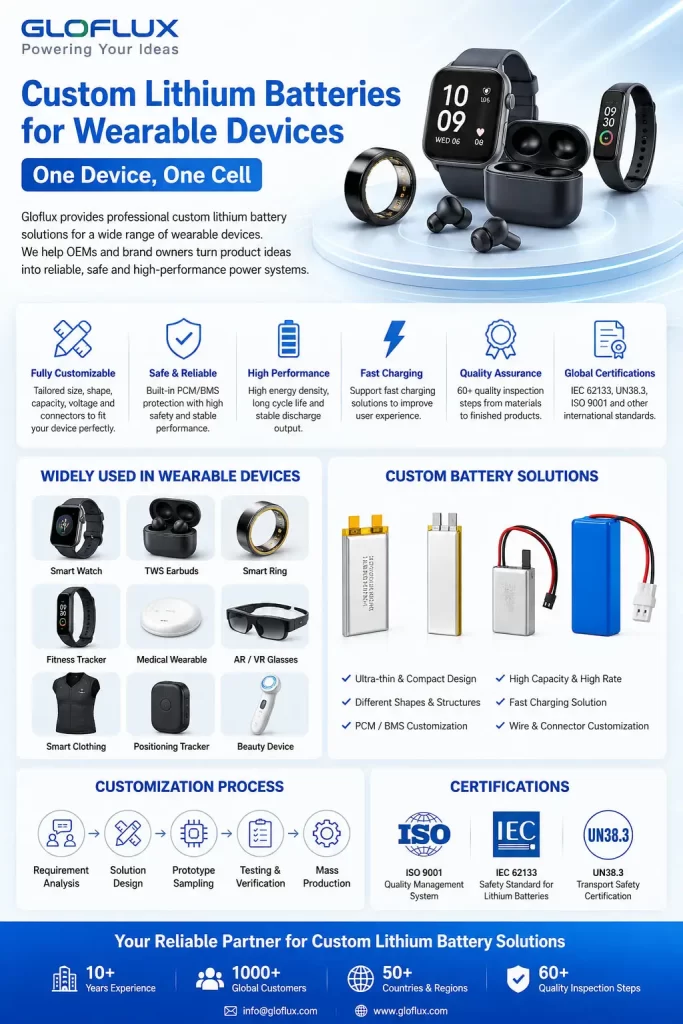
Behind every successful wearable device, there is one component that quietly determines the product’s real-world performance: the lithium battery.
For many product developers, choosing a battery may seem like a simple sourcing decision. However, in wearable electronics, the battery is not just a replaceable power unit. It directly affects product size, comfort, industrial design, safety, charging experience, and long-term reliability. This is why the wearable industry is moving toward a more customized battery development model: “one device, one cell.”
This approach means the battery is designed around the actual device, not forced into the device after the product structure has already been finalized. For OEMs and brand owners, custom lithium batteries are becoming essential for building competitive wearable products.
Why Standard Batteries Are Not Enough for Wearables
Unlike smartphones, tablets, or laptops, wearable devices do not have generous internal space. Their shape is often curved, thin, narrow, or irregular. A smartwatch must fit comfortably on the wrist. A medical patch must stay lightweight on the skin. Wireless earbuds must fit inside a tiny acoustic chamber. A smart ring must work within an extremely limited circular structure.
In these applications, standard battery models often create design compromises.
A battery may be too thick for the housing. It may not match the available internal space. It may provide insufficient capacity. It may interfere with sensors, antennas, speakers, or mechanical structures. In some cases, the battery can fit physically, but it cannot deliver the required discharge stability or cycle life.
This is why wearable battery design must begin with the device itself. Engineers need to consider product geometry, power consumption, charging method, user behavior, safety standards, and production feasibility together.
A custom lithium-ion battery allows the product team to optimize both the battery and the device structure at the same time.
The Meaning of “One Device, One Cell”
“One device, one cell” does not mean every battery must be completely different from scratch. Instead, it means the battery solution should be matched to the unique requirements of the product.
For example, two wearable devices may both use a 3.7V lithium-ion battery, but their design requirements can be completely different. A fitness tracker may prioritize slim thickness and long standby time. A medical monitoring patch may require stable discharge, high safety, and skin-contact reliability. A pair of true wireless earbuds may require compact size, fast charging, and high cycle performance. A smart ring may require an ultra-small curved or button-type battery structure.
The battery must support the product’s function, shape, and user experience. That is the core idea behind “one device, one cell.”
For OEMs, this approach reduces the risk of late-stage redesign. Instead of selecting a battery after the product structure is finished, the battery is considered early in the development process. This helps improve internal space utilization, avoid performance limitations, and accelerate the path from prototype to production.
Key Design Factors for Wearable Lithium Batteries
1. Size and Shape
Form factor is often the first challenge in wearable battery development. Wearable devices usually have limited and highly specific internal space. Even a small change in battery thickness, width, length, or corner radius can affect the final product design.
Custom lithium batteries can be designed in different shapes, including ultra-thin pouch cells, compact prismatic cells, curved layouts, narrow battery packs, or special structural configurations. The goal is to maximize available capacity without compromising product comfort or appearance.
For wearable devices, a well-matched battery can help reduce wasted internal space and support a more refined industrial design.
2. Capacity and Runtime
Battery capacity determines how long a wearable product can operate between charges. However, more capacity usually means a larger battery size. The challenge is to find the right balance between runtime and product dimensions.
A smartwatch may need all-day use. A medical wearable may need continuous operation for monitoring. A Bluetooth audio device may require stable playback time. A smart beauty device may need higher output during short operating cycles.
Custom battery development begins by analyzing the device’s power consumption profile. Engineers evaluate standby current, peak current, working modes, charging frequency, and actual user behavior. Based on this data, the battery capacity can be optimized for realistic runtime expectations.
3. Discharge Performance
Not all wearable devices consume power in the same way. Some require low continuous current, while others need short bursts of higher power.
For example, a wearable heating product, massage device, or beauty device may demand higher discharge capability than a simple sensor-based wearable. Wireless audio products may require stable power output to support sound processing, Bluetooth communication, and charging case interaction.
If the battery cannot provide stable discharge performance, the product may experience voltage drops, shutdowns, reduced performance, or shortened battery life.
This is why cell selection and battery pack design must match the device’s actual power demand.
4. Charging Speed and Safety
Modern users expect wearable devices to charge quickly. However, fast charging in compact batteries creates engineering challenges. Small lithium batteries are more sensitive to heat, overcurrent, and voltage control.
A safe fast-charging solution requires the right cell chemistry, protection circuit design, thermal consideration, and charging protocol. For wearable devices that come into close contact with the body, battery safety is especially important.
Custom lithium battery manufacturers must evaluate overcharge protection, over-discharge protection, short-circuit protection, temperature control, and charging stability. The goal is to improve convenience without increasing safety risks.
5. Cycle Life
Wearable devices are used frequently, and many are charged daily. This makes cycle life an important performance indicator.
A low-quality battery may perform well during early testing but lose capacity quickly after repeated charging and discharging. For consumer products, this leads to poor user experience and higher after-sales costs. For medical or industrial wearables, battery degradation can affect product reliability and safety.
A good wearable battery solution should maintain stable capacity over many cycles. This requires high-quality cells, controlled manufacturing, proper protection circuit design, and reliable testing.
6. Safety and Certification
Because wearable devices are often worn close to the body, battery safety cannot be treated as a secondary issue. A battery used in a wearable product must be designed with strict attention to safety performance.
Important considerations include cell consistency, insulation, protection circuit reliability, mechanical protection, swelling control, thermal stability, and transport safety.
For global markets, certifications such as IEC 62133 and UN38.3 are often required. These standards help verify battery safety and transport compliance, making them important for brands selling internationally.
Working with a battery manufacturer that understands certification requirements can help OEMs avoid delays during product launch.
How Custom Battery Development Supports OEM Projects
A professional custom lithium battery project usually begins with technical communication. The customer provides product drawings, space dimensions, voltage requirements, runtime targets, charging conditions, and application scenarios. The battery manufacturer then evaluates the project and recommends a suitable cell and pack design.
The development process may include:
- Battery size and structure evaluation
- Cell selection and capacity matching
- PCM or BMS design
- Wire and connector customization
- Charging and discharging performance optimization
- Prototype sampling
- Safety and reliability testing
- Certification support
- Mass production planning
This process allows the battery to become part of the product design rather than a limitation.
For wearable OEMs, early battery involvement can shorten the development cycle. It also reduces the risk of discovering battery-related problems late in the project.
Application Scenarios for Wearable Lithium Batteries
Custom lithium batteries are widely used in many wearable and compact electronic products.
Smartwatches and Fitness Trackers
These products require thin batteries, stable standby performance, and reliable cycle life. Battery design must support sensors, displays, wireless communication, and daily charging.
Medical Wearables
Medical patches, monitoring devices, and portable health equipment require stable power output and high safety standards. Long runtime and reliability are critical because the device may be used for continuous health tracking.
True Wireless Earbuds
Earbud batteries must fit in extremely small spaces while supporting fast charging, repeated cycles, and stable audio performance. The charging case also requires a matched battery solution.
Smart Rings
Smart rings have very limited internal space. The battery must be compact, lightweight, and carefully integrated with sensors and electronic components.
Beauty and Personal Care Devices
Wearable beauty devices may require higher power output for heating, vibration, light therapy, or microcurrent functions. Battery safety and discharge stability are key.
Industrial Wearables
Industrial safety devices, positioning tags, and wearable communication equipment often need durable batteries that can handle demanding environments and longer working hours.
Why Partnering with the Right Battery Manufacturer Matters
A wearable device is only as reliable as its power system. Choosing a battery supplier based only on price can lead to problems such as short runtime, unstable discharge, swelling, poor cycle life, certification failure, or inconsistent mass production quality.
A reliable lithium battery manufacturer should provide engineering support, strict quality control, customization capability, and certification guidance.
For brands developing wearable devices, the ideal battery partner should understand both battery technology and product integration. This includes how the battery fits into the housing, how it affects user comfort, how it performs during daily use, and how it supports the product’s market requirements.
Gloflux Custom Lithium Battery Solutions for Wearables
Gloflux provides custom lithium battery solutions for wearable devices and compact electronics. With experience in lithium-ion battery design, battery pack assembly, protection circuit configuration, and application-specific customization, Gloflux supports OEM customers from concept development to production.
Our team works with customers to evaluate product structure, capacity targets, voltage requirements, charging needs, discharge performance, safety standards, and certification requirements. Whether the project requires an ultra-thin cell, compact battery pack, high-rate discharge solution, fast-charging design, or special connector configuration, Gloflux provides flexible engineering support.
Through strict quality inspection and controlled production processes, Gloflux helps customers build safer and more reliable wearable products.
Conclusion: Better Wearables Start with Better Battery Design
As wearable devices continue to evolve, battery design will become even more important. Smaller products, richer functions, and higher user expectations all require more advanced power solutions.
The “one device, one cell” approach reflects a simple but powerful idea: the battery should be designed for the product, not forced into it. For wearable OEMs, this means better space utilization, improved runtime, safer operation, and stronger product competitiveness.
Custom lithium batteries are no longer optional for advanced wearable devices. They are a key part of product innovation.
If you are developing a wearable device and need a reliable custom lithium battery solution, Gloflux can support your project with engineering design, sample development, testing, and scalable manufacturing.
Talk to the Manufacturer
Resources & Insights
High Capacity Lithium Battery for Wearables: High-Voltage LiPo Cell Design
2026-10-19
Cylindrical Battery Packs for Laptops: 2S vs 3S vs 4S Battery Design
2026-10-19
Stage Lighting Battery Pack: Prevent Voltage Drop & LED Flicker
2026-10-19
Best Rechargeable Batteries for Smart Devices: Performance, Safety, and Selection Guide
2026-10-19


