


 Home /
 How To Choose A Custom LiPo Battery Manufacturer


Table of Contents
- 1. Understand Your Application Requirements First
- 2. Check the Manufacturer’s Engineering Capability
- 3. Evaluate Battery Safety and Protection Design
- 4. Review Quality Control Standards
- 5. Confirm Testing Capability
- 6. Ask About Certification Support
- 7. Consider Production Capacity and Delivery Stability
- 8. Check Customization Flexibility
- 9. Compare Communication and Project Support
- 10. Avoid Choosing Only by Price
- 11. Why Gloflux Is A Reliable Custom LiPo Battery Manufacturer
- Conclusion
Choosing the right custom LiPo battery manufacturer is an important decision for any company developing a battery-powered product. A LiPo battery is not only a component that stores energy. It directly affects product safety, runtime, charging performance, user experience, certification, and long-term reliability.
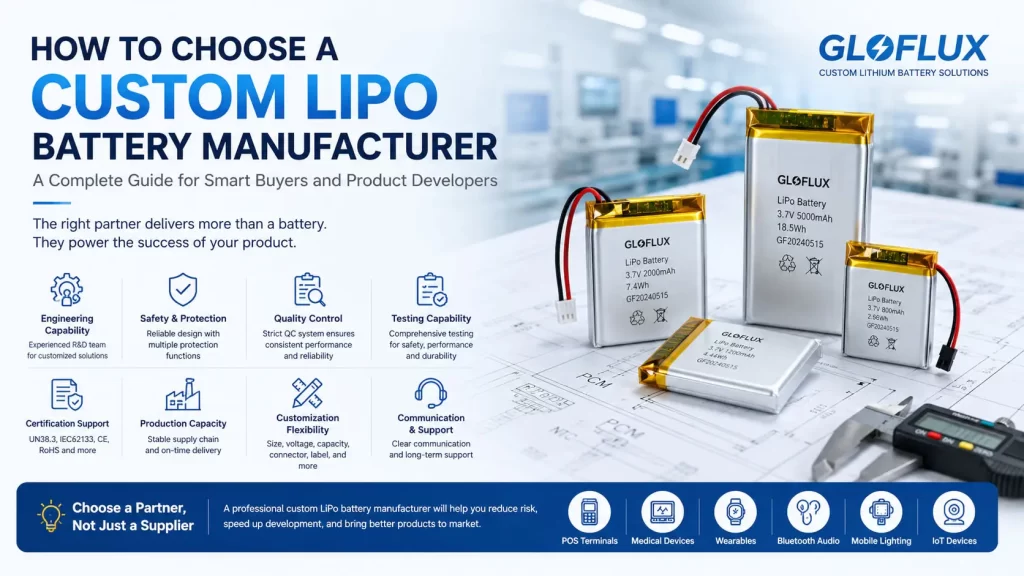
For products such as POS terminals, medical devices, smart wearables, Bluetooth audio devices, beauty equipment, mobile lighting, IoT devices, and portable electronics, a standard battery model may not always meet the required size, capacity, discharge rate, connector type, or safety requirements. This is why many brands and OEM customers choose a custom LiPo battery solution.
However, not every battery supplier has the same engineering capability, quality control system, production capacity, or certification experience. Before selecting a custom LiPo battery manufacturer, buyers should evaluate several key factors carefully.
1. Understand Your Application Requirements First
Before contacting a manufacturer, it is important to define the basic requirements of your battery-powered product. A reliable custom LiPo battery solution starts with clear technical information.
Key information may include:
- Product type and application scenario
- Required voltage and capacity
- Maximum battery dimensions
- Expected runtime
- Charging method
- Discharge current requirement
- Peak current requirement
- Operating temperature range
- Connector type and wire length
- Battery protection requirements
- Certification or transportation requirements
- Estimated order quantity
For example, a smart wearable device may need an ultra-thin LiPo battery with compact size and stable low-current discharge. A portable medical device may require higher safety standards, stable output, and certification support. A POS terminal may need long cycle life, reliable charging, and consistent performance during daily commercial use.
A professional custom LiPo battery manufacturer should be able to review these requirements and recommend a practical battery structure instead of simply offering a standard model.
2. Check the Manufacturer’s Engineering Capability
Custom LiPo battery development is not only about assembling cells. It requires engineering support in electrical design, mechanical structure, BMS protection, cell selection, testing, and production feasibility.
A qualified manufacturer should be able to support:
- LiPo cell selection
- Custom voltage and capacity design
- Battery pack structure design
- Protection circuit design
- BMS integration
- Connector and wiring customization
- Charging and discharging parameter evaluation
- Size optimization for compact products
- Safety risk assessment
- Sample development and testing
This is especially important for products with limited internal space. In many portable devices, the battery must fit into a narrow housing while still providing enough runtime and safe operating performance. A strong engineering team can help balance size, capacity, safety, and manufacturability.
When choosing a manufacturer, ask whether they can provide technical drawings, battery specifications, sample testing data, and design suggestions based on your actual device structure.
3. Evaluate Battery Safety and Protection Design
Safety is one of the most important factors when choosing a custom LiPo battery manufacturer. LiPo batteries must be designed with proper protection to reduce risks during charging, discharging, storage, transportation, and daily use.
Common protection functions include:
- Overcharge protection
- Over-discharge protection
- Overcurrent protection
- Short-circuit protection
- Temperature protection
- Cell balancing for multi-cell packs
- Charging control
- Discharge cutoff protection
For single-cell LiPo batteries used in compact electronics, a protection circuit module is often required. For multi-cell battery packs, BMS design becomes more important because voltage balance, current control, and safety monitoring must be managed more carefully.
A professional manufacturer should not only provide the battery cell but also help evaluate the protection circuit according to the end product’s real working conditions.
4. Review Quality Control Standards
Battery quality is strongly connected to consistency. Even if a sample performs well, mass production must maintain the same level of safety and performance.
When selecting a custom LiPo battery manufacturer, buyers should check whether the factory has a complete quality control process covering raw materials, production, testing, and final inspection.
Important quality control steps may include:
- Incoming material inspection
- Cell capacity grading
- Voltage and internal resistance matching
- Welding quality inspection
- Protection board testing
- Charging and discharging performance testing
- Aging test
- Appearance inspection
- Final voltage and capacity check
- Packaging inspection
For battery-powered products, poor batch consistency can lead to unstable runtime, charging issues, early failure, swelling, or customer complaints. A reliable manufacturer should have documented inspection standards and stable process control.
5. Confirm Testing Capability
Testing is essential for custom LiPo battery projects. A good manufacturer should be able to perform electrical, mechanical, and safety-related tests according to the application requirements.
Common battery tests include:
- Capacity test
- Cycle life test
- Charge and discharge test
- Internal resistance test
- Overcharge test
- Over-discharge test
- Short-circuit test
- Drop test
- Vibration test
- Thermal shock test
- High and low temperature test
- Storage performance test
For products used in medical, industrial, outdoor, or commercial environments, testing requirements may be more demanding. For example, a battery used in a mobile payment terminal may need stable daily charging performance, while a battery used in a portable medical device may require higher reliability and safety verification.
Testing capability shows whether the manufacturer can support real product development rather than only basic battery assembly.
6. Ask About Certification Support
For international markets, battery certification is a critical part of product development. Without proper certification and transportation documents, a product may face shipping delays, customs problems, or market access issues.
Common battery-related certifications and standards include:
- UN38.3
- MSDS
- IEC 62133
- CB
- CE
- RoHS
- UL
- KC
- CQC
Different countries, industries, and product categories may require different certifications. A professional custom LiPo battery manufacturer should understand these requirements and provide guidance during the design stage.
Certification should not be treated as the final step only. The battery structure, protection design, cell selection, labeling, and documentation should be considered early to reduce redesign risk.
7. Consider Production Capacity and Delivery Stability
For OEM and brand customers, supply stability is just as important as technical capability. A manufacturer may be able to make samples, but mass production requires stable capacity, trained workers, automated equipment, and reliable supply chain management.
When evaluating production capability, consider:
- Factory scale
- Production line automation
- Daily or monthly output capacity
- Sample lead time
- Mass production lead time
- Material sourcing stability
- Quality consistency across batches
- Packaging and shipping capability
If your project is expected to grow from prototype to mass production, choose a manufacturer that can support different stages of development. This helps avoid switching suppliers after the product has already entered the market.
8. Check Customization Flexibility
A key reason for choosing a custom LiPo battery manufacturer is flexibility. The supplier should be able to adjust the battery design according to product requirements.
Common customization options include:
- Battery size
- Battery shape
- Voltage
- Capacity
- Discharge rate
- Protection board
- Connector type
- Wire length
- NTC thermistor
- PCM or BMS design
- Label design
- Housing or wrapping
- Packaging method
For compact electronic devices, even small changes in battery thickness, wire direction, or connector position can affect assembly efficiency. A flexible manufacturer can help reduce mechanical interference and improve final product design.
9. Compare Communication and Project Support
Good communication can save time and reduce project risk. Battery customization often involves several rounds of evaluation, sampling, testing, and adjustment. If the manufacturer does not respond clearly or cannot understand technical requirements, the development process may become slow and inefficient.
A reliable supplier should provide:
- Clear technical communication
- Fast response to RFQ requests
- Professional review of drawings or samples
- Practical suggestions for improvement
- Transparent quotation details
- Sample and production schedule updates
- Test reports when required
- Long-term after-sales support
For international customers, English communication, export experience, and documentation support are also important.
10. Avoid Choosing Only by Price
Price is always important, but the lowest price is not always the best choice for custom LiPo batteries. A very low quotation may mean lower-grade cells, weak protection design, limited testing, unstable materials, or poor quality control.
When comparing quotations, buyers should check what is included:
- Cell brand and grade
- Capacity tolerance
- Protection circuit design
- Testing process
- Certification support
- Packaging method
- Sample cost
- Tooling or development cost
- Lead time
- Warranty terms
A better supplier should provide a balance of cost, safety, performance, and delivery reliability. For battery-powered products, quality problems can cost much more than the initial price difference.
11. Why Gloflux Is A Reliable Custom LiPo Battery Manufacturer
Gloflux provides custom lithium battery solutions for global customers, including LiPo batteries, lithium-ion battery packs, rechargeable battery solutions, replaceable batteries, and application-specific power systems.
With engineering experience, manufacturing capability, and strict quality control, Gloflux supports customers from early project evaluation to mass production.
Gloflux can provide:
- Custom LiPo battery design
- Ultra-thin battery solutions
- Compact battery packs for portable electronics
- Custom voltage and capacity options
- Protection circuit and BMS integration
- Connector, wire, label, and packaging customization
- Battery testing and quality inspection
- Certification support for global markets
- OEM and ODM battery manufacturing
Our battery solutions are widely used in POS terminals, medical devices, smart wearables, Bluetooth audio products, beauty devices, smart home products, mobile lighting, and other battery-powered applications.
Instead of only supplying standard batteries, Gloflux focuses on practical battery solutions that match each customer’s product structure, performance target, safety requirements, and production plan.
Conclusion
Choosing a custom LiPo battery manufacturer requires more than comparing price and capacity. Buyers should evaluate the manufacturer’s engineering capability, safety design, quality control, testing process, certification support, customization flexibility, and production stability.
A professional battery manufacturer should help customers select the right cell, design the right battery structure, reduce safety risks, support certification, and ensure stable mass production.
If you are developing a new battery-powered product or looking for a reliable custom LiPo battery manufacturer, Gloflux can help you create a safe, efficient, and production-ready LiPo battery solution for your application.
Talk to the Manufacturer
Resources & Insights
High Capacity Lithium Battery for Wearables: High-Voltage LiPo Cell Design
2026-10-19
Cylindrical Battery Packs for Laptops: 2S vs 3S vs 4S Battery Design
2026-10-19
Stage Lighting Battery Pack: Prevent Voltage Drop & LED Flicker
2026-10-19
Best Rechargeable Batteries for Smart Devices: Performance, Safety, and Selection Guide
2026-10-19


