


 Home /
 Custom Battery MOQ, Cost and Lead Time: What OEM Buyers Need to Know


Table of Contents
- What is the Average MOQ for a Custom Battery Pack?
- Can Buyers Order Samples Before Meeting the MOQ?
- How Much Does a Custom Battery Pack Cost?
- What Development Costs Should Buyers Expect?
- What Is the Lead Time for Custom Battery Samples?
- What Affects Mass-Production Lead Time?
- How Can Buyers Reduce Cost and Development Time?
- Working With GLOFLUX
- Conclusion
- Frequently Asked Questions
Each time an OEM customer wants to create a custom battery pack, he or she is likely to have three questions to ask: What is the minimum order quantity? What will the cost of developing be? How long will samples and mass production be?
Each project has its own solution. The Cost, Lead Time and Battery MOQ will vary according to the cell type and battery configuration, complexity of BMS, design of battery enclosure, testing requirements, certification plans and annual demand.
Being aware of these points before asking for a quote allows buyers to supply precise information and provide a fair comparison of suppliers, without any unforeseen delays.
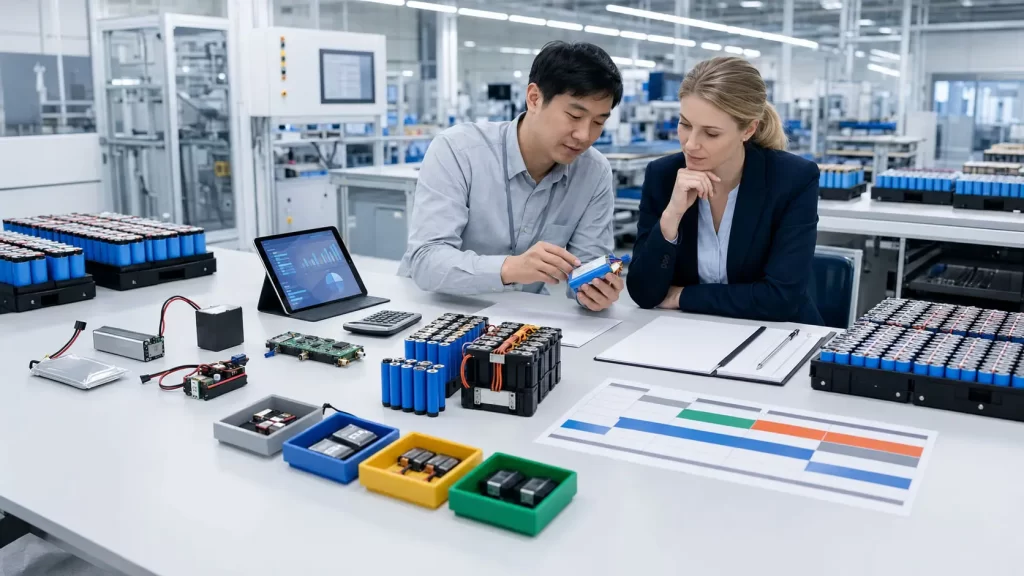
What is the Average MOQ for a Custom Battery Pack?
The minimum order quantity for a custom battery pack comes down to the extent of the design that needs to be developed exclusively for the customer.
A relatively simple pack using available cells, a standard protection board, heat-shrink packaging and an existing connector may support a smaller trial order. A battery requiring a custom enclosure, new BMS, specialized connector, communication protocol or uncommon cell may need a higher production quantity.
MOQ is commonly influenced by:
- Cell availability and supplier packaging quantity
- Custom BMS production requirements
- PCB manufacturing quantity
- Plastic enclosure tooling
- Custom cable and connector sourcing
- Label and packaging requirements
- Production setup costs
- Quality-control and testing procedures
Instead of looking only for the lowest MOQ, buyers should evaluate whether the supplier can maintain the same approved materials and specifications when the project moves into repeat production.
Can Buyers Order Samples Before Meeting the MOQ?
For most custom battery projects, prototypes are manufactured prior to meeting the mass production MOQ. Samples are employed for detecting electrical performance, physical fit, charging compatibility, connector polarity, communication and device runtime.
Sample unit prices are typically higher than prototype unit prices due to engineering work, manual assembly, materials sourcing and testing costs, etc. and usually the quantity is smaller than the production quantity.
A typical purchasing sequence is:
- Technical requirement review
- Preliminary battery proposal
- Specification and quotation confirmation
- Sample order
- Device testing and design adjustment
- Pilot production
- Mass-production order
This approach allows customers to validate the battery before making a larger purchasing commitment.
How Much Does a Custom Battery Pack Cost?
Final unit price is not dependent on voltage and capacity only—the full battery design is taken into consideration. The price of two packs can be very different even though they are the same size and rated to the same voltage and capacity, due to the cells, discharge characteristics, BMS features, packaging, and standards.
Cell Type and Chemistry
Cells typically are a large component of battery expense. The price of a cylindrical lithium ion cell differs from that of a lithium polymer pouch cell and LiFePO4, which are all options for lithium ion cells.
High energy density, high discharge rate, fast charging or wide temperature cells may be more expensive than standard cells. Other factors impacting price are cell brand, capacity consistency, cycle-life target, and supply availability.
Battery Configuration
The number of cells and series/parallel circuits directly affect material and assembly costs. The higher the voltage or capacity of a pack, the more cells are needed, the more connection materials are required, the larger the housing construction, and the more complex the manufacturing process.
BMS and Communication Functions
A basic protection circuit is less expensive than a smart BMS with:
- Cell balancing
- Temperature monitoring
- Fuel-gauge functions
- Data storage
- Bluetooth monitoring
- CAN communication
- UART, RS485, I²C or SMBus
- Charging and discharge control
Custom firmware and communication testing may also create additional development costs.
Enclosure and Mechanical Structure
Heat-shrink packaging typically does not involve as much development as does molded plastic or metal packaging. This could include prototyping in 3D, CNC prototyping, tooling for injection moulding and/or structural design for a new custom enclosure.
Other mechanical attributes like mounting brackets, handles, locking systems, waterproofing, shock protection and replaceable contacts also influence the cost.
Testing and Certification
The price of the test is based on the product category, battery configuration and the target market. Transport testing, safety testing, environmental testing or support for product-level certification may be needed for a project.
Discussions should begin early as the testing plan may differ depending on a change in cells, BMS or pack structure.
What Development Costs Should Buyers Expect?
Custom battery development may involve several one-time charges in addition to the sample price:
- Engineering and design fees
- Custom BMS development
- PCB setup
- Firmware development
- 3D-printed or CNC enclosures
- Injection-mold tooling
- Specialized test fixtures
- Certification and laboratory testing
- Custom labels and packaging setup
Not every project requires all of these charges. If the battery can use an existing cell, BMS and enclosure, development costs may be relatively limited. A completely new smart battery module will require more engineering and validation.
Buyers should ask suppliers to separate one-time development charges from recurring unit prices. This makes quotations easier to compare.
What Is the Lead Time for Custom Battery Samples?
All of these charges are not needed in all projects. Development costs can be relatively limited if the battery can utilize an existing cell, BMS and enclosure. It will need more engineering and validation to make a smart battery module all new.
Buyers should make sure suppliers provide one-off development costs, along with the unit price. This allows you to more easily compare quotations.
Sample lead time may include:
- Requirement and feasibility review
- Cell and component sourcing
- Electrical design
- BMS development
- Mechanical drawing
- Prototype enclosure production
- Battery assembly
- Testing and inspection
- Shipping preparation
If customers change the voltage, connector, dimensions or communication requirements after development begins, the sample timeline may need to be adjusted.
What Affects Mass-Production Lead Time?
Sample lead time is the time from confirmation of technical specification, price and design requirements. A lot of it really depends on the amount of materials and how complicated the design is.
- Cell inventory and production schedule
- BMS and PCB availability
- Custom enclosure supply
- Connector and cable delivery
- Order quantity
- Production-line capacity
- Aging and final testing
- Packaging requirements
- Export documentation
Forecasting is particularly important for repeat OEM orders. Providing estimated monthly or annual demand helps the manufacturer prepare cells and long-lead materials in advance.
How Can Buyers Reduce Cost and Development Time?
Customers can make the project more efficient by supplying clear information from the beginning.
Before requesting a quote, prepare:
- Nominal and charging voltage
- Required capacity or runtime
- Continuous and peak current
- Maximum battery dimensions
- Connector and wire specifications
- Device power data
- Operating temperature
- Communication requirements
- Certification destination
- Sample quantity
- Forecast order volume
Development cost and time can be saved by reusing an existing enclosure and/or standard cell or proven BMS platform. These, however, should only be used when they satisfy the performance and safety requirements of the product.
Working With GLOFLUX
GLOFLUX offers OEM/ODM service of lithium-ion, lithium polymer and LiFePO4 battery packs. Services include cell selection, pack configuration, BMS integration, connector customization, enclosure development, prototyping, testing and production.
Once the customer has been reviewed, the engineering team can determine what parts of the product should be entirely custom for the customer, and what parts might be modified or adapted to meet their needs. This allows for a more precise MOQ, development budget and project schedule to be provided.
Conclusion
The capacity is not enough to compute the MOQ, cost and lead time of the custom battery. The complete electrical design, mechanical structure, BMS functions, materials, testing plan and production volume are the factors on which they depend.
With detailed specifications and realistic demand forecasting, faster and more accurate quotations will be delivered to the OEMs. The prototype verification process also reduces risk prior to full-scale production and avoids costly design revisions and a more stable long-term supply program.
Frequently Asked Questions
1. What is the MOQ for a custom battery pack?
The MOQ is dependent on the cells, BMS, enclosure, connectors and customization level. Normally, prototype quantities are less than mass production quantities.
2. Why are custom battery samples more expensive?
This could involve engineering development, sourcing parts, manual assembly, prototype making of enclosures and testing of individual units, increasing the cost per unit.
3. Does a custom battery require a tooling fee?
For a new molded enclosure or a special component, tooling might be needed. Existing tooling might not be needed if heat-shrink packs or existing housings are applicable.
4. How long does it take to develop a custom battery?
The exact pace of the schedule may vary as per the complexity of the design, availability of materials, development of the BMS, requirement of enclosure, testing time, customer approval time.
5. How can I get an accurate battery quotation?
Give Voltage, Capacity, Working Current, Peak Current, Dimension, Connector, Charging Method, Operating Environment, Certification Market and Ordinal Quantity.
Talk to the Manufacturer
Resources & Insights
High Capacity Lithium Battery for Wearables: High-Voltage LiPo Cell Design
2026-10-19
Cylindrical Battery Packs for Laptops: 2S vs 3S vs 4S Battery Design
2026-10-19
Stage Lighting Battery Pack: Prevent Voltage Drop & LED Flicker
2026-10-19
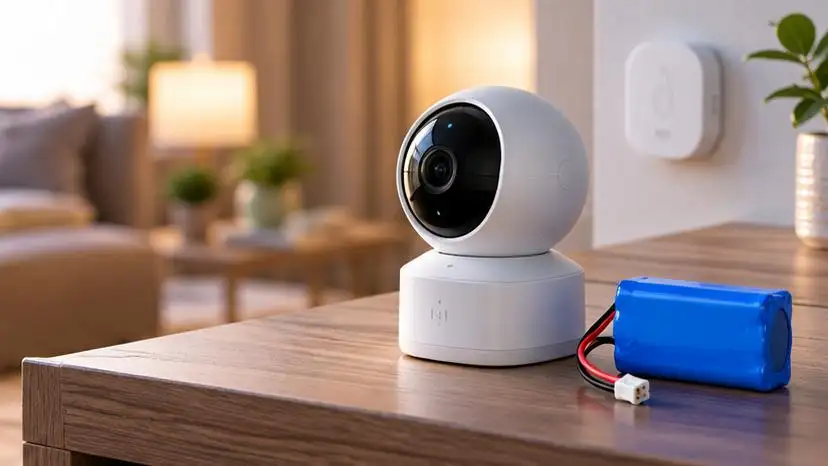
Best Rechargeable Batteries for Smart Devices: Performance, Safety, and Selection Guide
2026-10-19


