


 Home /
China Beauty Device Battery Manufacturer: Battery Heat Control


Table of Contents
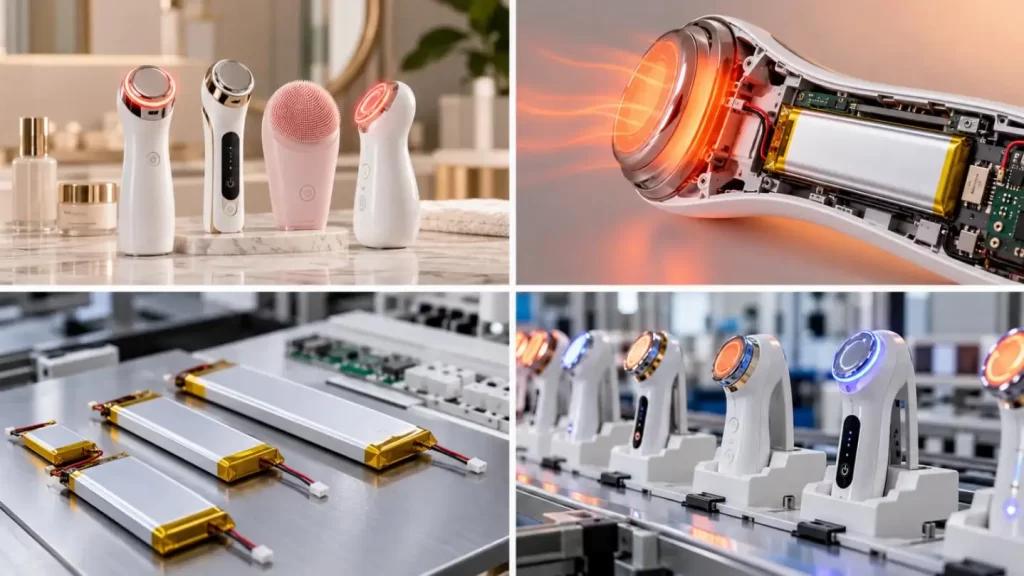
Heated facial devices develop a challenging thermal environment for rechargeable lithium-ion batteries. RF facial massagers, heated cleansing brushes and multifunctional skincare tools must control the temperature at skin contact while preventing excessive heating of the batteries in compact enclosures.
As a China Beauty Device Battery Manufacturer, GLOFLUX is able to address these needs via the selection of cells, control of internal resistance, NTC monitoring, thermal isolation, design of protection circuits, and control of manufacturing process.
The crucial engineering distinction is that the temperature of the heater, battery and enclosure are three separate parameters that require individual control and verification.

Thermal Load Analysis in Heated Facial Devices
Three Sources of Battery Temperature Rise
Heating of batteries occurs on multiple levels:
• Conductive: Heat flows through metal paths (i.e. battery heater brackets, PCB substrates, and other metal structural components).
• Electrochemical: Heating occurs through internal resistance and polarization during charging and discharging.
• Power Electronics: Localized heating occurs at charger ICs, MOSFETs, converters, and interconnects.
• Sealed/waterproof housings limit heat flow.
Repeated exposure to elevated temperatures can promote solid-electrolyte interphase (SEI) growth, electrolyte degradation, increase impedance and decrease capacity.
A China Beauty Device Battery Manufacturer needs to study the real-world effects of these phenomena on their batteries rather than solely relying on room-temperature battery specifications.
Internal Resistance and Battery Heat Generation
Calculating Resistive Losses
Battery resistive heating can be approximated by:
P_loss ≈ I²R
Where:
• I: Battery operating current (A)
• R: Effective internal resistance (Ω)
• P_loss: Resistive power dissipation (W)
Our 801840 LiPo cell provides an electrical reference:
Parameter GLOFLUX 801840
| Parameter | Value |
| Nominal Voltage | 3.7V |
| Rated Capacity | 500mAh |
| Internal Resistance | 60mΩ |
| Published Discharge Current | 3A |
| Nominal Dimensions | 8 × 18 × 40mm |
Using 60mΩ as an illustrative resistance:
• Current
• Current Calculated Resistive Loss
• 1A 0.06W
• 2A 0.24W
• 3A 0.54W
• Doubling current increases resistive losses fourfold.
These calculations are illustrative; operating resistance varies with temperature, state of charge, aging, and measurement method. Published discharge capability does not establish suitability for continuous operation beside a heating element.
Selecting 3.7V or 7.4V Battery Architecture
For equivalent output power, a 7.4V configuration generally requires less pack current than a 3.7V configuration, assuming comparable conversion efficiency.
However, two-series-cell systems introduce additional protection, cell-matching, and balancing requirements.
We evaluate voltage architecture against peak power, converter efficiency, available space, and the complete thermal budget.
LiPo vs Cylindrical Li-ion Battery Selection
| Engineering Factor | LiPo Pouch Cell | Cylindrical Li-ion Cell |
| Form Factor | Thin, Customizable | Standardized Cylindrical |
| Thermal Interface | Broad Flat Surfaces | Curved Contact Surfaces |
| Mechanical Protection | Requires Pouch Support | Rigid Metal Casing |
| Installation Clearance | Swelling Allowance Required | Diameter And Mounting Space |
| Typical Suitability | Slim Facial Instruments | Larger Handheld Devices |
GLOFLUX can provide customized LiPo configurations with selected thicknesses of approximately 3mm or less, depending on capacity and discharge requirements, as well as structural considerations.
There are numerous design challenges relating to managing the temperature of the batteries and retaining mechanical stability.
NTC Temperature Monitoring and Protection Coordination
Sensor Accuracy Depends on Installation
Temperature is measured indirectly using an NTC thermistor through changes in resistance.
An accurate measurement system requires:
• R25 and B-value Selection: Selection of the best circuit elements to resemble the characteristics of the thermistor.
• Thermal Coupling: Control of the thickness of the adhesive and contact pressure to change the time constant to desired value.
• Measurement Accuracy: Compensate for the resolution of the ADC and tolerance of the sensing resistor.
• Fault Detection: Diagnose short circuits, open circuits and other types of failures.
Multiple thermistors are needed to measure large temperature gradients across a heater-to-cell.
Coordinating Protection Electronics
| Component | Thermal Management Function |
| NTC | Cell temperature feedback |
| PCM/BMS | Configured battery protection |
| Charger IC | Temperature-dependent charging |
| MCU | Heater regulation and fault response |
The MCU can reduce heating power before battery temperature reaches its protection threshold.
However, software regulation should not replace independent battery protection.
Simultaneous heating and charging requires particular attention because charger losses, heater conduction, and battery self-heating can overlap.
Thermal Isolation and Mechanical Integration
Thermal insulation reduces heater-to-battery conduction but may also trap battery-generated heat.
We discuss three designs.
• Physical Separation: A longer thermal path between the heating element and battery will reduce the temperature in the system.
• Controlled Heat Spreading: Heat is conducted to the proper regions of the enclosure while keeping the cells cool.
• Thermal Power Derating: When the measured temperatures of the system approach limits, charging current and/or heater power is reduced.
There are several mechanical design elements that must be considered, including pouch swelling, tab orientation, wire routing and insulation, tolerance stack-ups, and a myriad of other design elements.
GLOFLUX Manufacturing Precision and Quality Control
GLOFLUX is the global brand of Huizhou Kaiyesheng Energy Co., Ltd. (KYS), our manufacturing and R&D foundation in Huizhou, China.
Founded in 2016, KYS operates a 30,000m² manufacturing facility, employs over 800 people, and reports an annual production capacity exceeding 100 million lithium batteries.
Our OEM/ODM services cover cell selection, custom battery design, protection electronics, prototyping, testing, and volume manufacturing.
Dimensional Precision and Process Control
Dimensional accuracy affects battery mounting, insulation clearance, connector alignment, and thermal interface repeatability.
Our specifications provide measurable references:
| Manufacturing Reference | Specification |
| 801840 LiPo nominal dimensions | 8 × 18 × 40mm |
| Selected standard smart battery pack | 75.0 × 20.5 × 20.5mm |
| Same smart pack dimensional tolerance | ±0.2mm per dimension |
| Quality inspection system | 60+ inspection checkpoints |
The ±0.2mm tolerance applies to the specified standard smart battery pack, not universally to our custom beauty-device batteries. Application-specific tolerances require approved drawings and inspection criteria.
Our production quality control emphasizes:
• Cell dimensions, thickness consistency, and pouch sealing integrity.
• Internal resistance and capacity consistency.
• Tab welding, connection resistance, and insulation integrity.
• NTC positioning, protection circuit testing, and batch traceability.
Thermal Validation and Certification Requirements
A China Beauty Device Battery Manufacturer should verify complete battery behavior within the assembled device.
| Validation Test | Required Evidence |
| Continuous heating | Cell and enclosure temperature profiles |
| Elevated ambient operation | Worst-case thermal response |
| Heating during charging | Current derating and temperature stability |
| NTC fault simulation | Fault detection and safe shutdown |
| Thermal cycling and aging | Capacity and impedance changes |
Our in-house testing and certification support cover applicable requirements associated with IEC 62133, UN38.3, UL, CB, CE, RoHS, CQC, and KC.
We will discuss IEC 62133-2 concerning portable lithium battery safety and UN38.3 regarding transportation testing. The applicable documentation should be confirmed for each configuration and destination market.
For Heated Facial Device Projects
Prior to battery selection, it is best to provide heater power, peak current, enclosure dimensions, charging conditions, operating cycles, and thermal limits.
At GLOFLUX, we cover the entire spectrum of design engineering for battery development, from electrical to mechanical and thermal.
GLOFLUX provides OEM/ODM lithium batteries for your device. You are welcome to contact us to discuss battery options that meet your performance, safety and service requirements.
FAQs
Q1: Does GLOFLUX support NTC temperature monitoring?
Yes. We support NTC integration for battery temperature monitoring, helping device controllers detect abnormal thermal conditions and regulate charging or operation.
Q2: Does GLOFLUX manufacture batteries for heated facial devices?
GLOFLUX develops customized LiPo and Li-ion battery solutions suitable for heated facial devices, including thermal monitoring and protection circuit integration.
Q3: What battery types does GLOFLUX offer for beauty devices?
We offer LiPo pouch cells and cylindrical Li-ion batteries, with configurations selected according to device dimensions, capacity, and discharge requirements.
Q4: What is the minimum battery thickness GLOFLUX can customize?
Selected GLOFLUX LiPo configurations can reach approximately 3mm thickness, depending on capacity, electrical requirements, and mechanical design.
Q5: What manufacturing precision does GLOFLUX provide?
One GLOFLUX smart battery pack specifies dimensional tolerances of ±0.2mm. Custom battery tolerances depend on approved drawings and product requirements.
Talk to the Manufacturer
Resources & Insights
High Capacity Lithium Battery for Wearables: High-Voltage LiPo Cell Design
2026-10-19
Cylindrical Battery Packs for Laptops: 2S vs 3S vs 4S Battery Design
2026-10-19

Stage Lighting Battery Pack: Prevent Voltage Drop & LED Flicker
2026-10-19

Best Rechargeable Batteries for Smart Devices: Performance, Safety, and Selection Guide
2026-10-19


