


 Home /
 Choosing the Best Trolling Motor Battery in 2026


Table of Contents
- What Is a Trolling Motor Battery?
- Why Battery Choice Matters in 2026
- Understanding Trolling Motor Battery Types
- 1. Flooded Lead-Acid Batteries
- 2. AGM Batteries
- 3. Lithium Batteries
- Why LiFePO4 Batteries Are Popular for Trolling Motors
- Understanding Battery Voltage
- Understanding Ah Capacity
- How Long Should a Trolling Motor Battery Last?
- Weight Considerations for Marine Batteries
- Charging Speed Matters More in 2026
- Smart Battery Management Systems (BMS)
- Marine Durability and Waterproofing
- Can You Mix Battery Types?
- How to Maintain a Trolling Motor Battery
- Why Portable Energy Trends Are Changing Marine Batteries
- How to Choose the Best Trolling Motor Battery in 2026
- The Future of Marine Battery Technology
- The Role of Gloflux in Portable Energy Solutions
- Final Thoughts
- FAQ About Trolling Motor Batteries
A trolling motor battery does far more than simply power a boat. It affects runtime, speed consistency, fishing performance, portability, charging efficiency, and overall reliability on the water. In 2026, modern anglers and marine users are no longer choosing batteries based only on price. Instead, they prioritize longer runtime, lightweight portability, fast charging, and dependable deep-cycle performance.
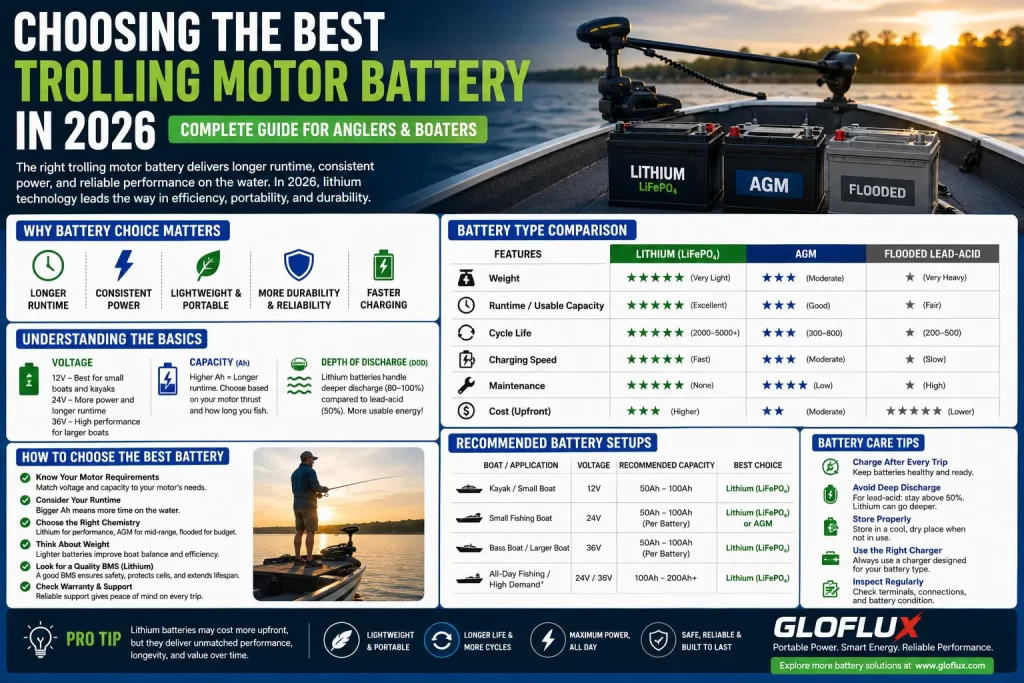
With lithium battery technology advancing rapidly, many boat owners are now replacing traditional lead-acid systems with more efficient lithium solutions. However, choosing the best trolling motor battery still depends on several important factors, including battery chemistry, voltage, capacity, charging compatibility, and marine operating conditions.
At Gloflux, we focus on portable energy solutions and advanced rechargeable battery technologies designed for modern mobility and energy storage applications. This guide explains how to choose the best trolling motor battery in 2026 and which battery types work best for different boating environments.
What Is a Trolling Motor Battery?
A trolling motor battery powers electric trolling motors commonly used on fishing boats, kayaks, and small marine vessels.
Unlike starter batteries that deliver short bursts of high current, trolling motor batteries are designed for:
- Long-duration energy output
- Deep-cycle discharge
- Stable continuous power delivery
- Repeated charging cycles
These batteries help support:
- Quiet fishing operation
- Boat maneuverability
- Position holding
- Slow-speed propulsion
- Extended time on the water
Because trolling motors operate continuously for hours, battery selection becomes extremely important.
Why Battery Choice Matters in 2026
Modern marine users expect much more from portable energy systems than they did a few years ago.
In 2026, buyers increasingly prioritize:
- Longer runtime
- Lightweight battery systems
- Faster charging capability
- Portable power efficiency
- Compact battery design
- Better low-maintenance performance
- Smart Battery Management Systems (BMS)
Traditional lead-acid batteries still exist, but lithium technology is rapidly becoming the preferred choice for many trolling motor applications.
Understanding Trolling Motor Battery Types
There are three primary battery categories commonly used with trolling motors.
1. Flooded Lead-Acid Batteries
Flooded lead-acid batteries remain one of the most affordable options.
Advantages
- Lower upfront cost
- Widely available
- Proven technology
Disadvantages
- Heavy weight
- Regular maintenance required
- Shorter lifespan
- Slower charging
- Lower efficiency
Flooded batteries may still work well for occasional users, but they are becoming less attractive for frequent boating applications.
2. AGM Batteries
AGM (Absorbent Glass Mat) batteries are a more advanced form of lead-acid battery.
Advantages
- Maintenance-free design
- Better vibration resistance
- Improved charging efficiency
- More stable marine performance
Disadvantages
- Heavier than lithium
- Higher cost than flooded batteries
- Limited lifespan compared to lithium
AGM batteries remain popular for mid-range marine systems.
3. Lithium Batteries
Lithium batteries, especially LiFePO4 (Lithium Iron Phosphate), are becoming the leading choice for trolling motors in 2026.
Advantages
- Lightweight construction
- Longer cycle life
- Faster charging
- Higher energy efficiency
- Deeper usable capacity
- Stable voltage output
- Lower maintenance
Disadvantages
- Higher upfront cost
- Requires compatible charging systems
Although lithium batteries cost more initially, many users consider them a better long-term investment due to longer lifespan and superior runtime.
At Gloflux, portable lithium battery solutions continue gaining popularity for marine and portable energy applications where efficiency and portability matter most.
Why LiFePO4 Batteries Are Popular for Trolling Motors
LiFePO4 batteries offer several important advantages specifically for marine environments.
Lightweight Performance
Weight reduction is one of the biggest benefits.
Lithium batteries can weigh significantly less than comparable lead-acid batteries, helping improve:
- Boat balance
- Portability
- Fuel efficiency
- Easier installation
Longer Runtime
Lithium batteries typically provide more usable capacity because they support deeper discharge levels without major performance loss.
Stable Voltage
Unlike lead-acid batteries that gradually lose voltage during discharge, lithium batteries maintain more consistent output throughout operation.
This improves:
- Trolling motor performance
- Speed consistency
- Efficiency on long fishing trips
Longer Lifespan
Many LiFePO4 batteries provide thousands of charge cycles, significantly outperforming traditional lead-acid systems.
Understanding Battery Voltage
Trolling motors commonly use:
- 12V systems
- 24V systems
- 36V systems
Higher voltage systems generally support:
- Larger boats
- Stronger thrust
- Better efficiency
- Longer runtime under heavy load
12V Systems
Best for:
- Kayaks
- Small fishing boats
- Light-duty use
24V Systems
Best for:
- Mid-sized fishing boats
- Longer operation time
- Higher thrust motors
36V Systems
Best for:
- Larger bass boats
- Heavy-duty fishing applications
- High-performance trolling motors
Always match battery voltage with motor specifications.
Understanding Ah Capacity
Amp Hours (Ah) measure battery capacity and directly affect runtime.
Higher Ah ratings provide:
- Longer operation time
- Fewer charging interruptions
- Better all-day performance
Example
A 100Ah battery generally lasts longer than a 50Ah battery under the same load conditions.
However, runtime depends on:
- Motor speed
- Water conditions
- Boat weight
- Wind resistance
- Battery chemistry
How Long Should a Trolling Motor Battery Last?
Battery runtime varies depending on motor power demand and battery size.
Typical Runtime Factors
- Lower motor speeds increase runtime
- Larger Ah batteries last longer
- Lithium batteries often provide more usable energy
For anglers spending long hours on the water, runtime becomes one of the most important purchasing factors.
Weight Considerations for Marine Batteries
Marine portability matters more than many users expect.
Heavy batteries create challenges during:
- Boat transport
- Installation
- Maintenance
- Charging
Lithium batteries dramatically reduce system weight while maintaining strong runtime performance.
For kayaks and portable fishing setups, lightweight batteries provide major advantages.
Charging Speed Matters More in 2026
Modern users increasingly expect fast charging capability.
Lithium batteries generally charge faster because they:
- Have lower internal resistance
- Support higher charging efficiency
- Maintain stable voltage during charging
Fast charging becomes especially valuable for:
- Tournament fishing
- Multi-day boating trips
- Portable marine systems
- Frequent users
Smart Battery Management Systems (BMS)
Modern lithium trolling motor batteries often include integrated Battery Management Systems.
A BMS helps protect against:
- Overcharging
- Overheating
- Deep discharge
- Short circuits
- Cell imbalance
These systems improve both safety and battery lifespan.
At Gloflux Battery Solutions, intelligent battery protection and portable energy optimization remain important priorities across modern battery systems.
Marine Durability and Waterproofing
Marine environments create challenging conditions for batteries.
Important factors include:
- Vibration resistance
- Moisture protection
- Saltwater exposure resistance
- Thermal stability
Lithium batteries often perform better in vibration-heavy environments because of their internal structural stability.
Can You Mix Battery Types?
Generally, mixing battery chemistries within the same trolling motor system is not recommended.
Avoid mixing:
- Lithium and lead-acid batteries
- Different Ah capacities
- Different battery ages
Inconsistent battery behavior can reduce performance and shorten battery lifespan.
How to Maintain a Trolling Motor Battery
Proper maintenance extends battery lifespan significantly.
For Lead-Acid Batteries
- Check water levels regularly
- Avoid deep discharge
- Keep terminals clean
- Store fully charged
For Lithium Batteries
- Use compatible chargers
- Avoid extreme temperatures
- Store partially charged for long-term storage
- Monitor BMS status if available
Lithium batteries generally require far less maintenance than flooded lead-acid systems.
Why Portable Energy Trends Are Changing Marine Batteries
The marine industry increasingly overlaps with portable energy technology.
Modern boating users now expect:
- Lightweight portable systems
- Fast charging support
- Compact battery design
- Longer runtime
- Smart energy management
These expectations are accelerating lithium battery adoption across fishing and recreational marine markets.
How to Choose the Best Trolling Motor Battery in 2026
The best battery depends on your boating style and performance needs.
Choose Lead-Acid If You Need:
- Lower initial cost
- Occasional boating use
- Basic trolling applications
Choose AGM If You Need:
- Maintenance-free performance
- Moderate runtime improvements
- Better durability than flooded batteries
Choose Lithium If You Need:
- Lightweight portability
- Long runtime
- Faster charging
- Premium performance
- Long-term reliability
For many serious anglers, lithium batteries now offer the best balance of performance and efficiency.
The Future of Marine Battery Technology
Battery technology continues evolving rapidly across marine applications.
Future trends include:
- Higher energy density
- Smarter BMS integration
- Faster marine charging systems
- Lightweight modular batteries
- Improved low-temperature performance
- Portable power integration
As portable energy systems become more advanced, marine batteries will continue improving in efficiency, runtime, and portability.
The Role of Gloflux in Portable Energy Solutions
At Gloflux, we focus on advanced battery technologies designed for evolving portable power applications.
Our battery solutions support:
- Portable electronics
- Replaceable battery systems
- Lithium battery packs
- Energy storage systems
- Compact portable power applications
As marine users increasingly prioritize efficiency and lightweight portability, lithium battery systems continue becoming central to modern energy solutions.
Final Thoughts
Choosing the best trolling motor battery in 2026 involves balancing runtime, portability, charging efficiency, and long-term reliability.
Lead-acid batteries remain affordable, AGM batteries offer maintenance-free convenience, and lithium batteries deliver the highest overall performance for serious marine users.
For many anglers and portable marine applications, lithium batteries now provide the best combination of:
- Lightweight construction
- Longer runtime
- Faster charging
- Stable voltage output
- Reduced maintenance
Understanding battery chemistry, voltage, and Ah capacity helps users build more reliable and efficient trolling motor systems for modern boating environments.
FAQ About Trolling Motor Batteries
What is the best battery type for trolling motors?
LiFePO4 lithium batteries are increasingly considered one of the best options because of lightweight design, long lifespan, and strong runtime performance.
How many Ah do I need for a trolling motor?
Many users choose 50Ah–100Ah depending on motor size, runtime needs, and boat type.
Are lithium batteries worth it for trolling motors?
For frequent users, lithium batteries often provide better long-term value through longer lifespan and improved efficiency.
Can I use a car battery for a trolling motor?
Starter batteries are not ideal because trolling motors require deep-cycle discharge performance.
How long do trolling motor batteries last?
Battery lifespan depends on chemistry, charging habits, and usage conditions. Lithium batteries generally last much longer than lead-acid systems.
Talk to the Manufacturer
Resources & Insights
High Capacity Lithium Battery for Wearables: High-Voltage LiPo Cell Design
2026-10-19
Cylindrical Battery Packs for Laptops: 2S vs 3S vs 4S Battery Design
2026-10-19
Stage Lighting Battery Pack: Prevent Voltage Drop & LED Flicker
2026-10-19

Best Rechargeable Batteries for Smart Devices: Performance, Safety, and Selection Guide
2026-10-19


