


 Home /
 3.7V Lithium Polymer Battery Guide | Uses & Technical Details


Table of Contents
-
Lithium Polymer Battery 3.7V: Full Performance and Technical Guide
- The 3.7V Lithium Polymer Battery Technology
- Technical Specifications and Engineering Behavior
- Reasons Why the 3.7V LiPo Battery is a Favorite Energy Solution
- Protection Systems and Safety Features
- Lithium Polymer Battery 3.7V Uses
- Selecting the Correct 3.7V LiPo Battery
- Technical Insights of Gloflux Product Range
- Best Practices in Maintenance and Charging
- Conclusion:
Lithium Polymer Battery 3.7V: Full Performance and Technical Guide
One of the most common rechargeable energy sources in contemporary electronics is a 3.7V Lithium Polymer Battery. From small IoT devices to mighty drones, this miniature yet mighty energy cell has been the foundation of portable power systems. Its popularity is not a mere coincidence; it has a lightweight structure, high energy density, and stable voltage output in a flexible pouch format.
The 3.7V Lithium Polymer Battery Technology
A 3.7V Lithium Polymer Battery (also known as a 3.7V LiPo Battery) is a rechargeable energy source, a single-cell battery, which uses polymer as an electrolyte rather than a liquid electrolyte. The change enhances flexibility, safety, and form factor. The battery is essentially a single-cell LiPo battery with a nominal voltage of 3.7 volts and a fully charged voltage of 4.2V.
Key Technical Characteristics:
• Nominal Voltage: 3.7V
• Charge Cutoff Voltage: 4.2V
• Discharge Cutoff Voltage: 3.0V
Type of chemistry: Lithium-ion polymer battery cell
• Form: Flat pouch-shaped lithium battery.
• Energy Density: Lithium polymer battery system of high energy density.
• Design: LiPo battery design (single cell).
This renders it a lightweight 3.7V lithium polymer cell that can be used in small and high-performance devices.
Technical Specifications and Engineering Behavior
The lithium polymer rechargeable battery engineering design is aimed at stability, efficiency, and long life cycle performance.
Core Technical Parameters
- A standard LiPo battery of 3.7 V would have the following specifications:
- Nominal Capacity: 300mAh to 10,000mAh (depends on use)
- Internal Resistance: Low internal resistance to high current output.
- Discharge Rate (C-rate): 1C-30C depending on model.
- Cycle Life: 300 to 1000+ charge cycles
- Charging Method: Constant Current / Constant Voltage (CC/CV)
- Protection: Battery Protection Circuit Module (PCM / PCB)
Performance Behavior
One of the best attributes of LiPo chemistry is the voltage stability under load. The voltage drop is controlled even with high discharge rates and hence suitable for sensitive electronics. Other significant behaviors are:
• Quick reaction to load variations.
• Power transfer with high efficiency.
• Minimal loss of energy during discharge.
• Constant thermal performance at normal conditions.
This is the reason why it is a popular high-efficiency power storage cell.
Reasons Why the 3.7V LiPo Battery is a Favorite Energy Solution
The advent of portable electronics has led to the need for small and efficient sources of energy. The LiPo cell of 3.7 volts is unique in terms of its size, weight, and power output.
Key Advantages
- Lightweight rechargeable battery solution
- High-energy-density lithium polymer battery.
- Small energy storage design.
- Fast charging lithium polymer battery support.
- Rechargeable battery performance with long cycle life.
- Constant performance at different loads.
These characteristics render it a rechargeable 3.7V LiPo battery that can be used by consumers and industry.
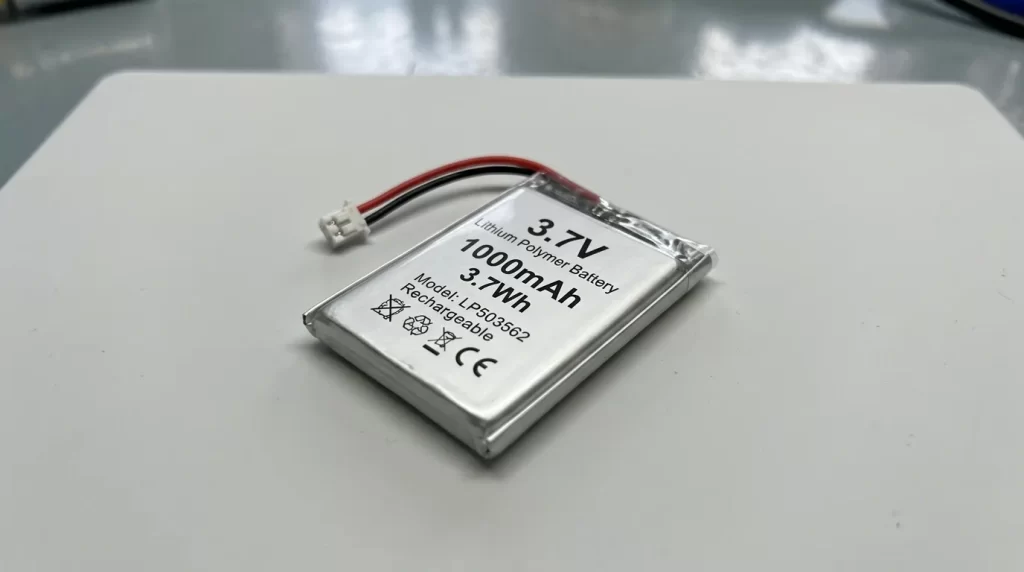
Protection Systems and Safety Features
One of the key considerations in lithium-based battery technology is safety. A well-constructed 3.7V LiPo battery with a protection circuit will be reliable in the long term.
Protection Mechanisms:
• Overcharge protection (cut-off at 4.2V)
• Over-charge (cut-off at 3.0V) protection.
• Short circuit protection
• Temperature monitoring system
• Existing control through PCM / PCB.
These systems are combined into a 3.7V LiPo battery protection circuit (PCB) to make sure that they can be used safely in any environment.
Lithium Polymer Battery 3.7V Uses
The LiPo drone and electronic 3.7 V battery is a common battery in the industry because of its versatility.
IoT and Smart Devices
- Battery for IoT devices
- Wireless sensor battery.
- Intelligent home surveillance.
Drones and RC Systems
- 3.7 V LiPo drone and RC battery with high capacity.
- Aerial systems and RC toys.
Consumer Electronics
- Wearable devices battery of 3.7V.
- Portable electronics
- Intelligent devices and controllers.
Tracking and Communication
- LiPo 3.7 V battery to power the GPS tracker.
- Asset tracking devices
- Remote monitoring systems
This flexibility renders it a small energy storage system in contemporary electronics.
Industrial and OEM Usage
There is a growing need in the industrial world to have custom and scalable power solutions.
Industrial Applications:
- Industrial rechargeable battery systems.
- Assembling battery packs.
- Custom 3.7V LiPo battery solutions
- Wholesale LiPo battery chains.
Such systems demand high-performance and rechargeable battery packs with long cycle life.
Selecting the Correct 3.7V LiPo Battery
The choice of the right battery is based on the needs of the application.
Key Selection Factors:
• Capacity (mAh rating)
• Discharge rate (C-rate)
• Size and weight constraints
• Protection circuit integration
• Cycle life expectations
For example:
- Low-power sensors have small-capacity cells.
- Drones have large-discharge-rate batteries.
- IoT devices need long cycle life and stability.
Technical Insights of Gloflux Product Range
The 3.7V lithium polymer battery offered by Gloflux is aimed at performance-oriented applications, where stability and durability are important.
The product line targets:
• High energy density power cells
• Stable voltage output systems
• Lightweight rechargeable structures
• Industrial-grade reliability
This renders it applicable in engineering prototypes and commercial implementation.
Best Practices in Maintenance and Charging
When properly handled, the battery life and safety are guaranteed.
Best Practices:
• Use CC/CV charging method
• Do not deep discharge under 3.0V.
• Store at 40–60% charge level
• Do not store in high temperatures.
• Use certified charging circuits.
These steps enhance the performance of the cycle life of the lithium polymer battery.
Conclusion:
The 3.7 V Lithium Polymer Battery is not just a source of power; it is a cornerstone of portable technology today. Its energy density, safety, and compactness render it indispensable in all applications, including IoT systems and high-performance drones. With the increasingly intelligent and smaller devices, this battery technology is evolving alongside them, and providing consistent and steady energy where it is needed the most.
Gloflux is the place to be when you want to find a high-performance and reliable energy solution. Select the 3.7 V Lithium Polymer Battery and energize your invention with certainty, accuracy, and efficiency.
Talk to the Manufacturer
Resources & Insights

High Capacity Lithium Battery for Wearables: High-Voltage LiPo Cell Design
2026-10-19
Cylindrical Battery Packs for Laptops: 2S vs 3S vs 4S Battery Design
2026-10-19

Stage Lighting Battery Pack: Prevent Voltage Drop & LED Flicker
2026-10-19
Best Rechargeable Batteries for Smart Devices: Performance, Safety, and Selection Guide
2026-10-19


