


 Home /
 2.0Ah Battery vs 4.0Ah Battery: Key Differences, Benefits, and Best Uses


Table of Contents
- What Does Ah Mean in a Battery?
- 2.0Ah vs 4.0Ah: The Core Difference
- Runtime Comparison
- Weight and Portability Differences
- Battery Voltage vs Battery Capacity
- Charging Time Differences
- Which Battery Is Better for Cordless Tools?
- Lithium-Ion Technology Makes Both More Efficient
- How Battery Cells Affect Capacity
- Battery Lifespan Considerations
- Heat Generation and Efficiency
- Which Battery Is Better for Portable Electronics?
- Why Battery Capacity Trends Are Changing in 2026
- Battery Safety Still Matters
- How to Choose Between 2.0Ah and 4.0Ah
- Future Battery Development
- The Growing Role of Portable Energy Solutions
- Final Thoughts
- FAQ About 2.0Ah vs 4.0Ah Batteries
Battery capacity has become one of the most important considerations when choosing cordless tools, portable electronics, backup power systems, and smart battery-powered devices. Many users often compare 2.0Ah and 4.0Ah batteries when deciding between lightweight portability and longer runtime.
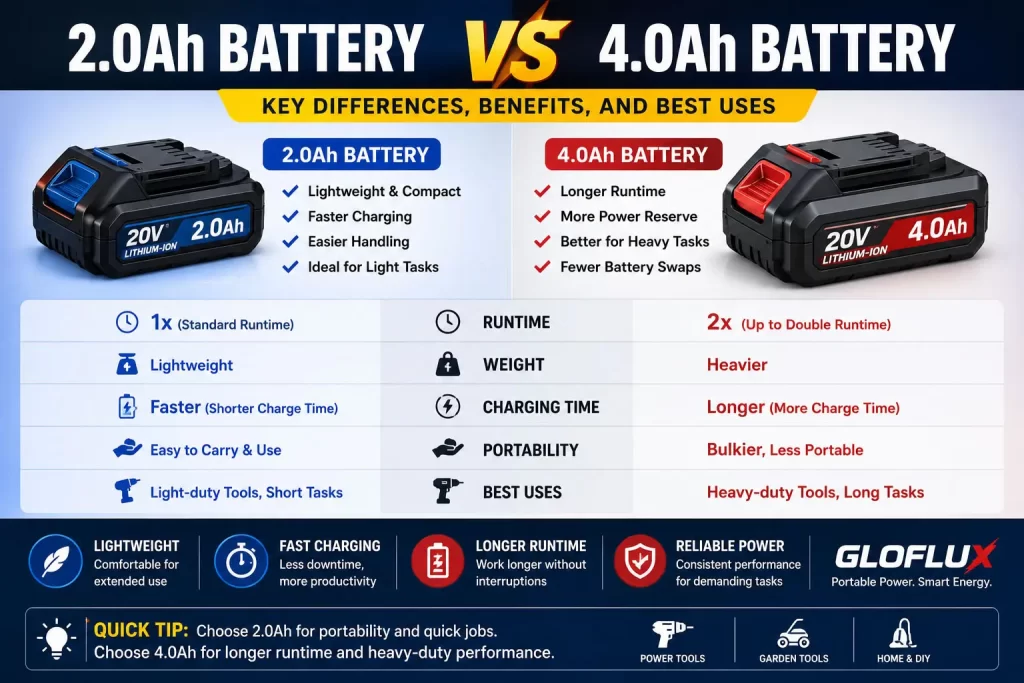
Although both battery types may share the same voltage, their real-world performance can feel very different depending on the application. Understanding how Amp Hours (Ah) affect runtime, charging, portability, and efficiency can help buyers choose the right battery for daily use.
At Gloflux, we focus on portable energy solutions and rechargeable battery technologies designed for modern electronics, mobility products, and portable power systems. This guide explains the differences between 2.0Ah and 4.0Ah batteries, their advantages, and which applications benefit most from each option.
What Does Ah Mean in a Battery?
Amp Hours (Ah) measure battery capacity. The Ah rating indicates how much electrical current a battery can deliver over time.
For example:
- A 2.0Ah battery can theoretically provide 2 amps for 1 hour
- A 4.0Ah battery can theoretically provide 4 amps for 1 hour
The higher the Ah rating, the more energy the battery can store.
Battery capacity directly affects:
- Runtime
- Weight
- Charging duration
- Portability
- Device operating time
However, Ah does not automatically determine power output. Voltage and battery chemistry also influence overall performance.
2.0Ah vs 4.0Ah: The Core Difference
The primary difference between 2.0Ah and 4.0Ah batteries is energy storage capacity.
4.0Ah≈2×2.0Ah
In simple terms:
- A 4.0Ah battery stores approximately twice as much energy as a 2.0Ah battery
- Runtime is generally about two times longer under similar load conditions
For users running cordless devices continuously, runtime becomes one of the biggest deciding factors.
Runtime Comparison
Runtime depends on device power consumption.
Example
Suppose a cordless device draws 2 amps continuously.
A 2.0Ah battery may provide:
2A2.0Ah=1 hour
A 4.0Ah battery may provide:
2A4.0Ah=2 hours
Actual runtime varies depending on:
- Motor efficiency
- Device load
- Temperature
- Battery age
- Battery chemistry
- Operating conditions
Still, the general rule remains consistent: higher Ah means longer runtime.
Weight and Portability Differences
A major advantage of 2.0Ah batteries is portability.
2.0Ah Battery Advantages
- Lighter weight
- Easier handling
- Reduced hand fatigue
- More compact design
- Better for overhead or mobile use
These batteries work especially well for:
- Compact cordless tools
- Portable electronics
- Lightweight consumer devices
- Occasional-use equipment
4.0Ah Battery Advantages
- Longer runtime
- Reduced battery swapping
- Better for continuous workloads
- More stable extended operation
However, larger capacity usually means:
- Increased weight
- Larger physical size
- Longer charging time
For professional or high-demand applications, many users accept the extra weight in exchange for longer operation.
Battery Voltage vs Battery Capacity
Many users mistakenly confuse voltage with Ah ratings.
Voltage Determines Power
Voltage affects the strength and power delivery of the device.
Ah Determines Runtime
Ah affects how long the battery operates before recharging.
For example:
- Two 20V batteries may have different Ah ratings
- Both provide the same voltage
- The higher Ah battery simply lasts longer
This distinction is important when comparing battery performance.
Charging Time Differences
Higher-capacity batteries typically require longer charging times.
Example
Using the same charger:
A 2.0Ah battery charges faster than a 4.0Ah battery because it stores less energy.
Basic charging estimation:
Charging Time≈Charging CurrentBattery Capacity
If using a 2A charger:
2.0Ah battery:
2A2.0Ah=1 hour
4.0Ah battery:
2A4.0Ah=2 hours
Real charging time is usually slightly longer due to charging efficiency and thermal management.
Which Battery Is Better for Cordless Tools?
The answer depends on the usage scenario.
Choose 2.0Ah Batteries If You Need:
- Lightweight handling
- Short-duration tasks
- Improved portability
- Less wrist fatigue
- Better maneuverability
Best for:
- Screwdrivers
- Drills for light work
- Indoor maintenance
- Household tasks
- Compact portable tools
Choose 4.0Ah Batteries If You Need:
- Longer runtime
- Heavy-duty workloads
- Outdoor projects
- Continuous operation
- Higher energy demand
Best for:
- Saws
- Grinders
- Lawn equipment
- High-load cordless tools
- Commercial applications
Lithium-Ion Technology Makes Both More Efficient
Modern 2.0Ah and 4.0Ah batteries commonly use lithium-ion chemistry.
Lithium-ion batteries offer several advantages over older battery technologies:
- Higher energy density
- Lower self-discharge
- Faster charging
- Longer lifespan
- Reduced memory effect
- Lightweight construction
These advantages support modern cordless systems, portable electronics, and energy storage products.
At Gloflux, lithium battery solutions are designed to improve both portability and operational efficiency across multiple applications.
How Battery Cells Affect Capacity
Battery capacity often increases by adding more cells or higher-capacity cells internally.
Typical Configuration Differences
A 4.0Ah battery may include:
- Additional battery cells
- Larger-capacity lithium cells
- Improved energy storage architecture
This explains why 4.0Ah batteries are usually larger and heavier than 2.0Ah versions.
Battery Lifespan Considerations
Battery lifespan depends on:
- Charging habits
- Temperature
- Usage cycles
- Storage conditions
- Discharge depth
Can Larger Batteries Last Longer?
In many cases, yes.
Because 4.0Ah batteries require fewer recharge cycles for the same total work output, they may experience less long-term wear in heavy-use environments.
However, both battery sizes can achieve long service life when properly maintained.
Heat Generation and Efficiency
Higher-capacity batteries often handle demanding loads more efficiently because they distribute power across more cells.
This can provide:
- Lower thermal stress
- Improved stability under load
- Better continuous performance
For high-power tools or extended operation, larger-capacity batteries may perform more consistently.
Which Battery Is Better for Portable Electronics?
For portable consumer devices, battery choice depends heavily on portability priorities.
2.0Ah Batteries Work Well For:
- Compact electronics
- Lightweight devices
- Travel-friendly systems
- Occasional use products
4.0Ah Batteries Work Well For:
- Longer outdoor use
- Portable power stations
- Extended backup runtime
- Energy-demanding devices
Modern portable power systems increasingly balance lightweight design with high-capacity lithium storage.
Why Battery Capacity Trends Are Changing in 2026
Battery expectations continue evolving rapidly in 2026.
Consumers increasingly prioritize:
- Longer runtime
- Fast charging
- Lightweight construction
- Portable energy storage
- Smart battery management systems
- Compact high-density battery design
This creates demand for batteries that combine:
- High energy density
- Better thermal control
- Improved portability
- Longer service life
Manufacturers are responding with more advanced lithium battery platforms and smarter charging systems.
Battery Safety Still Matters
Regardless of battery size, safety remains critical.
Modern lithium batteries often include:
- Overcharge protection
- Temperature monitoring
- Short-circuit protection
- Battery Management Systems (BMS)
- Voltage balancing
These systems help improve both performance and long-term reliability.
At Gloflux Battery Solutions, battery safety and charging stability remain important priorities across portable energy applications.
How to Choose Between 2.0Ah and 4.0Ah
The best battery depends on your usage habits.
Choose 2.0Ah If You Value:
- Portability
- Lightweight handling
- Short projects
- Compact devices
- Better mobility
Choose 4.0Ah If You Value:
- Longer runtime
- Continuous operation
- Reduced charging interruptions
- Higher-demand equipment
- Outdoor or professional use
Some users even keep both options available for different situations.
Future Battery Development
Battery manufacturers continue investing in:
- Higher energy density
- Faster charging systems
- Safer lithium chemistry
- Smaller form factors
- Better thermal management
- Longer cycle life
As portable electronics and cordless systems become more powerful, battery capacity optimization will remain a major industry focus.
The Growing Role of Portable Energy Solutions
Portable energy systems are no longer limited to cordless tools.
Modern lithium batteries now power:
- Portable power stations
- Outdoor electronics
- Emergency backup systems
- Smart mobility products
- Compact industrial devices
- Consumer electronics
At Gloflux, portable battery technology continues evolving to meet changing user expectations for runtime, portability, and charging efficiency.
Final Thoughts
The difference between 2.0Ah and 4.0Ah batteries comes down to balancing runtime and portability.
A 2.0Ah battery provides:
- Lightweight convenience
- Better maneuverability
- Faster charging
- Compact portability
A 4.0Ah battery provides:
- Longer operation time
- Better heavy-load performance
- Reduced battery swapping
- Improved continuous runtime
Neither option is universally better. The right choice depends on how and where the battery will be used.
As lithium battery technology continues improving in 2026, users can expect even greater energy density, faster charging, and more compact portable power systems across consumer and industrial markets.
FAQ About 2.0Ah vs 4.0Ah Batteries
Does a 4.0Ah battery provide more power?
Not necessarily. Voltage determines power output, while Ah mainly affects runtime.
Is a 4.0Ah battery heavier?
Yes. Larger-capacity batteries usually contain more battery cells and weigh more.
Which battery charges faster?
A 2.0Ah battery typically charges faster because it stores less energy.
Can I use a 4.0Ah battery instead of 2.0Ah?
In most compatible systems, yes, as long as voltage and battery platform compatibility match.
Which battery lasts longer overall?
A 4.0Ah battery generally provides longer runtime per charge cycle.
Talk to the Manufacturer
Resources & Insights

High Capacity Lithium Battery for Wearables: High-Voltage LiPo Cell Design
2026-10-19
Cylindrical Battery Packs for Laptops: 2S vs 3S vs 4S Battery Design
2026-10-19

Stage Lighting Battery Pack: Prevent Voltage Drop & LED Flicker
2026-10-19

Best Rechargeable Batteries for Smart Devices: Performance, Safety, and Selection Guide
2026-10-19


